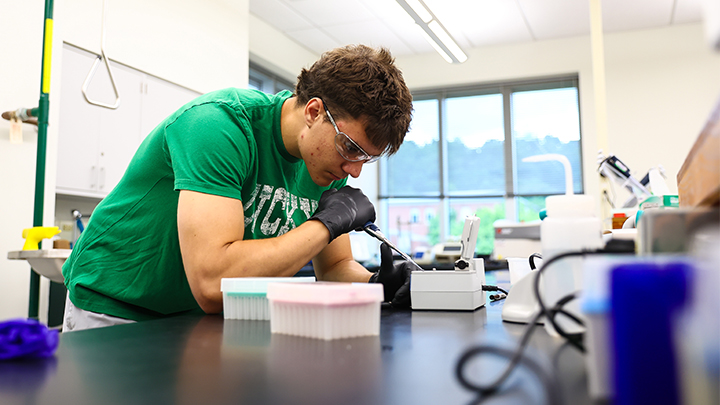
At Slippery Rock University, undergraduate students gain valuable research experiences and drive innovation working alongside faculty. Cooper Alleman, a junior chemistry major from Slippery Rock (Slippery Rock HS), is benefiting from this first-hand through an in-depth research project into alpha-synuclein, a protein found in the human body primarily within brain neurons.
Alleman’s project, titled “Probing Binding Dynamics of Alpha-Synuclein by a Novel Histidine Label and Electron Spin Resonance,” is under the direction of Jessica Sarver, an SRU assistant professor of chemistry. The pair’s study focuses on probing the membrane binding dynamics of alpha-synuclein, which are proteins that help facilitate the chemical transmission of signals in the brain. The misfolding and clustering of these proteins are also linked to neurodegenerative diseases like Parkinson’s.
“Through this research we can discern things that could be helpful for people in the future, as well as push the field further,” Alleman said.
Alleman and Sarver are generating alpha-synuclein, isolating it, cleaning it and using electron spin resonance, or ESR, to measure signals that will inform the researchers about the protein’s structure, dynamics and motion. Their goal is to learn how alpha-synuclein reacts across different membrane environments to record how its binding behavior changes.
Alleman’s primary role has centered on creating and isolating this protein in the lab with essential histidine mutations. Histidine is an essential amino acid crucial for protein synthesis, tissue growth and repair. Its unique chemical structure allows it to bind to metals such as iron, copper, zinc and nickel. Leveraging this property alongside ESR allows Alleman and Sarver to advance their research and uncover key characteristics of the protein.
To generate the protein, the researchers cultivated specific environments using bacterial colonies, a process that Sarver describes as a form of “protein expression.”
“In this field, you’ll find a protein that you want to investigate, but you need to find a way to make enough of it to put it in an instrument and analyze it,” Sarver said. “For us, we basically hijacked E. coli cells just to make protein, and those cells became little machines for us.”
Under Sarver’s guidance, Alleman’s professional and academic growth remained at the center of the ongoing project. Alleman plans to attend medical school and studying alpha-synuclein provided essential hands-on experience in laboratory methods and scientific research.
“What drew me to this project was how intricate it was,” Alleman said. “There was so much that I didn’t understand going into it, and it was honestly so fun to dive into this and learn a lot of new things. I’m getting a lot out of this that I didn’t anticipate.”
As an example, Alleman referenced his preparation for the MCAT, the exam used for medical school admissions, and how he is able to apply his experience from the research project.
“Lab techniques are a huge section on the MCAT,” Alleman said. “Thanks to this research, I’m familiar with a lot of techniques that I had never heard of before.”
And thanks to SRU’s commitment to academic excellence and innovation, he was able to gain this experience. Alleman and Sarver’s project is funded by an internal Summer Collaborative Research Experience grant that is approved by SRU’s Undergraduate Research, Scholarship and Creative Activity Committee.
More information about the chemistry program at SRU can be found on the program’s webpage.