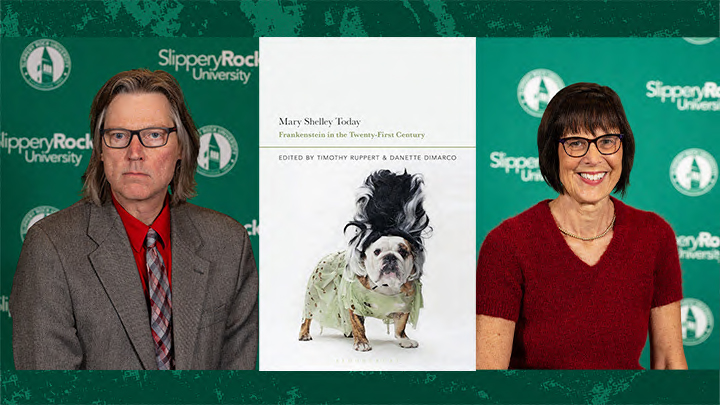
Two Slippery Rock professors collaborated as anthology editors of a book containing essays from all over the world about the continuing relevance of Mary Shelley’s “Frankenstein.”
Timothy Ruppert, associate professor of languages, literatures, cultures and writing, wrote the first chapter, the afterword and co-authored the introduction with Danette DiMarco, professor of languages, literatures, cultures and writing.
The book, “Mary Shelley Today: Frankenstein in the 21st Century,” examines the influence of Mary Shelley and “Frankenstein” on literature, film and television over the past 25 years, exploring how contemporary creators reinterpret Shelley’s life, ideas and themes of isolation, dehumanization and monstrosity.
Editor’s Origin Story
Writing this book was not something Ruppert planned.
“It started off as a completely different project,” Ruppert said, who originally planned to independently write a monagraph on the pre-Raphaelite art movement.
“I lost the sight in my one eye,” Ruppert explained. “So it became very difficult for me to work on such an extensive project.”
He invited DiMarco, who had previously collaborated with him on two publications: the book “Avian Aesthetics in Literature and Culture: Birds and Humans in the Popular Imagination” and an in-house publication titled “Pandemic University.” Rather than focusing on the pre-Raphaelites, where the conversation would be “a little sparser,” Ruppert and DiMarco looked to “Frankenstein,” something that Ruppert said would seem to have a bit more contemporary appeal.
Ubiquity of ‘Frankenstein’
Ruppert and DiMarco chose to focus on “Frankenstein” due to the overwhelming amount of direct and indirect adaptations of the original story.
“Adaptations of Frankenstein are so relevant to contemporary audiences, and by the time you put the book together, there are already other things that could be in the book as chapter topics, because they just keep coming out so fast,” Ruppert said. “For example, we had already assembled most of the book, then (filmmaker Guillermo) del Toro comes out with his adaptation of “Frankenstein.”
“By the time we talked about that in the introduction, there were two or three other films that had been released, and I had to mention them in the afterword.”
Ruppert could not escape “Frankenstein,” even when he tried.
“After having spent three years editing this collection, I said, ‘I just need a break from ‘Frankenstein’ for a little bit,’ so I picked up a contemporary mystery called ‘My Husband’s Wife.’ This is a really terrific mystery, but ends up going, in later chapters, into being a kind of adaptation of ‘Frankenstein.’”
DiMarco, meanwhile, kept encountering “Frankenstein” through her study of young adult literature, citing novels like “Pride and Prometheus” by John Kessel, and works from other genres, including “The Dark Descent of Elizabeth Frankenstein” by Kiersten White.
“It’s just pervasive throughout literary culture and pop culture,” Ruppert said.
Themes of ‘Frankenstein’
Ruppert believes that “Frankenstein” references are so common due to the wide breadth and relevance of the original novel’s themes.
“It speaks to certain kinds of primal human conflicts, inner and outer,” Ruppert said.
He emphasized the relevance of “Frankenstein” in applications of artificial intelligence and an increasingly digital age.
“One of the strongest chapters in the book is all about an author named Ken Liu, who built his own computer and programmed it and then collaborated with this computer on a short piece, Ruppert said. “Then the author looks at this short piece and what it has to say on storytelling and narration and, by extension, sentience.”
Ruppert also mentioned themes of feminism, loneliness and belonging.
“You also have various kinds of interpretations of moral considerations, like my own chapter is about ethics,” Ruppert said.
“‘Frankenstein’ has such a lot to say about technology and human intervention into nature that these things continue to speak to people at the level of questions of artificial intelligence, questions of what we do to the environment, ecological concerns, what we do to each other in terms of gender relations.
“It’s vague to say they’re universal but they’re definitely relevant,” Ruppert said.
“Mary Shelley Today” will be released in December. More information about the book can be found on the publisher Bloomsbury’s website.