

Carmella Ryan is turning her fascination with the human brain into lasting impactful research in the cognitive neuroscience field.
Ryan, a Slippery Rock University junior psychology major from West Sunbury (Moniteau HS), and Shannon McKnight, instructor of psychology, have spent the year preparing to collect data determining how emotion interacts with cognitive processes.
“I’ve always been interested in the brain, and how we can only do something when the brain is firing,” Ryan said. “Without a process occurring, we wouldn’t be able to function in our daily living.”
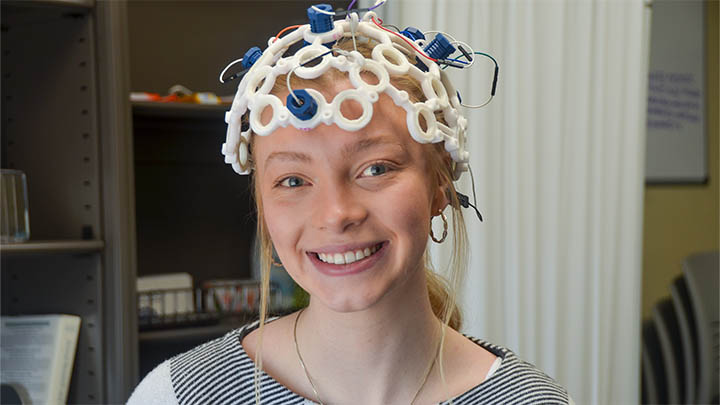
The student-faculty duo is testing emotional words related to time for emotional memory encoding as part of study to analyze late-positive potential, which is the increase in brain activity when a person sees something emotionally meaningful or attention-grabbing.
Participants in the study will view emotional words on a screen and an electroencephalogram (EEG) will measure their brain activity in response to perceiving each word.
Results of the study will be used to help clinicians better assess various mental health diagnosis and help neuroscientists better understand emotional memory.
Ryan has spent her college career studying the late-positive potential, starting in her research methods class and leading into an independent capstone study for her neuroscience concentration.
The work to time EEG triggers has been highly precise and exhaustive, as Ryan has spent a semester tagging 2,200 words with emotional association, narrowing the list to only the strongest, research-backed 120.
The daunting preparatory tasks have not dimmed her motivation. Instead, the project has reaffirmed her choice to study human brain activity.
“I have more of a passion to help and serve other people through my research,” Ryan said.
According to McKnight, Ryan’s drive is what made her stand out as a student researcher as early as the professor’s first day.
“Carmella is dedicated to doing her own research,” McKnight said. “The EEG part of things is my expertise, but the emotional processing that she’s studying is not something I’ve ever studied before, so she’s been telling me all about what she thinks is underneath it.”
Her initial goal was clinical practice in neurology, but Ryan’s studies have encouraged her to continue her education and research in a Ph.D. program. As a provider in the psychiatric unit at Butler Memorial Hospital, Ryan sees firsthand the need for more research and wants to help make a difference.
“I love the brain so much, and I’ll be a brain geek for the rest of my life,” Ryan said. “I wasn’t sure going into neuroscience three years ago if that was going to be my field, but I got in and immediately knew that’s what I wanted to do for the rest of my life.”
Eligible adults can register to participate in Ryan and McKnight’s study using this form.
More information about the psychology degree at SRU is available on the program’s webpage.