
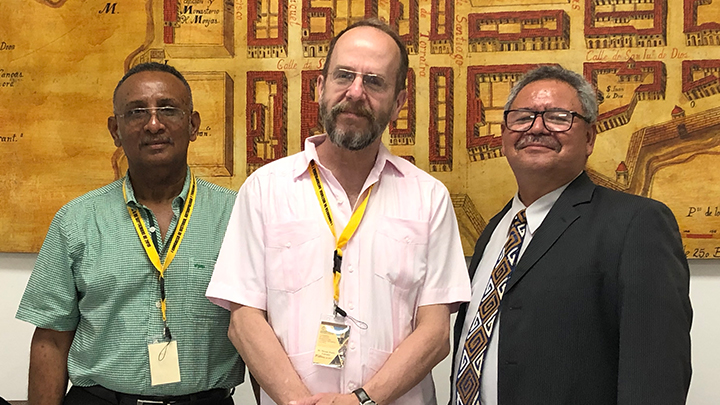

Thomas Pearcy’s distinguished career as a scholar of Latin American studies has reached a new level of collaborative achievement. The Slippery Rock University history professor helped catalog thousands of documents from the archives of Panamanian president Belisario Porras, alongside scholars throughout Central America as part of a project called Historians Without Borders that puts Panamanian history back into the hands of its people.
Pearcy’s project, which started with some documents found in a university library and conversations between scholars in the United States and Central America on WhatsApp, was founded upon Pearcy’s commitment to transparency, truth and autonomy in the formation of national histories.
“When I started working in Panama in the 1980s, Panamanian history was written by people sitting in air conditioning in Washington, D.C., or in the Panama Canal Zone,” Pearcy explained. “I decided very early in my career that that was wrong. People who look and sound like me should not be flying to another part of the world and telling them their history.”
This conviction was put into action when Pearcy and fellow Latin American scholar Fernando Aparicio stumbled upon the Porras documents in the library of Universidad de Panamá in the early 1990s.
“After finding those documents, Fernando and I put our heads together and estimated there were 10,000 documents,” Pearcy said.
The early scanning and PDF converting of the documents occurred at Brigham Young University where Pearcy established the Rey L. Pratt Center for Latin American Studies.During this process, it was revealed that there were actually 30,000 documents, all of which had hitherto been completely unavailable to the Panamanian public. At the end of the scanning process, the documents were digitized, but no more organized that they had been in paper form.
“About a year ago, a former research assistant of mine reached out and used experimental AI to translate, annotate and organize the documents,” Pearcy said. “I was astounded.”
The arrival of this new technology led Pearcy to decide that it was time to go full speed ahead on getting the documents out to the public. By the end of this spring, the project will be done, thanks to the support from an SRU student, Aiden Myers, a sophomore computing major from Cranberry Township (Pennsylvania Cyber Charter HS).
Myers is creating a website and once it is published, , Pearcy is relinquishing all control to the Panamanians.
Pearcy’s commitment to accurate historical accounts written by the rightful stewards of a nation’s history is evident in his teaching and research, with a feedback loop between personal experience, research and classroom activity.
“When I speak on something in my classroom, I’m speaking from experience,” Pearcy said. “(I speak about) about death squads, about governmental cover-ups, about poverty. I want my students to learn to not be prejudiced and to not be judgmental, but to look at other human beings as equally significant.”
Some of these experiences came from the time that Pearcy spent in one of his proudest moments in his career. Pearcy spent significant time in the 1980s and 1990s speaking with and advocating for the property rights of citizens of Viejo Veranillo, a impoverished community in Panama known as “barriadas brujas” or squatter settlement.
“We conducted interviews with people living in these squatters’ communities who weren’t counted by the Census Bureau and who lived on 10-by-12-foot parcels in houses with dirt floors and thatch roofs with no windows or doors,” Pearcy said. “They could have been kicked off of their land at any time. Finally in 2023, the government of Panama buckled, because we were writing articles about this in Spanish and English. Those families got their land.”
While Pearcy’s experiences are illuminating, he doesn’t want his students to simply hear what he says and take his word for it.
“I encourage my students not to believe me,” Pearcy explained. “I want them to go find the documents. I want them to think critically and not just to accept someone else’s opinion.”
More information about history at SRU can be found on the program’s webpage.