
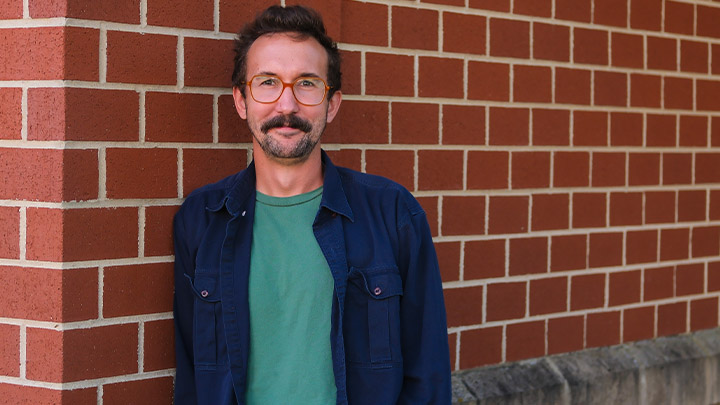

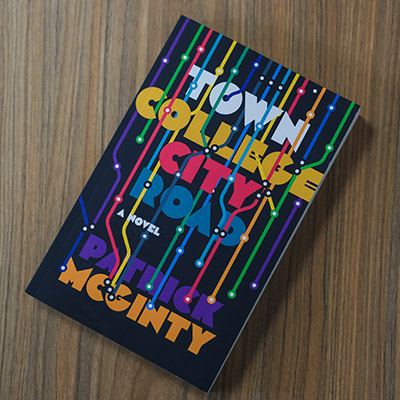
A Slippery Rock University professor wrote a novel that explores the precarious relationship between Rust Belt America and the technology sector. In his book titled “Town College City Road,” Patrick McGinty, an associate professor of languages, literatures, cultures, and writing, tells the story of Kurt Boozel, a queer math prodigy who grew up in a small, struggling Rust Belt town in western Pennsylvania. As the main character studies economics in college, he starts a high-pressure Wall Street job, becomes curious about cryptocurrency, and ultimately returns home.
This book, now available and published through University of Wisconsin press, was a long time coming for McGinty in many ways. His roots go deep in western Pennsylvania. He was born and raised in the region, spending a significant amount of time with his grandparents in Grove City while growing up. The writing process for this novel began while he was away in Oregon after receiving his Master of Fine Arts at Portland State University, but it was completed after he returned to the area that had inspired him so much to begin with.
McGinty centers the notion of “rural mythology” in the novel. Some examples he offered of rural mythology include ways of engaging with family, the imperative to stay in one’s town of birth, and heteronormativity, all of which can potentially be damaging elements of life in an oftentimes stagnant and insular community. In the book, Boozel, like so many young people feeling let down by their homes, attempts to flee from that environment and to chase wealth and prestige.
“He thinks, ‘If I make enough money, I’ll be able to break free,’ rather than attempting to modify and update and help to change that community from within in necessary ways to help it to grow,” McGinty said of his protagonist. “I think I’m somebody who is a ‘stayer.’ I like to stay and fix. I’m a big believer in sticking around and having difficult conversations.”
As someone who likes to stick around and help to make change, McGinty finds himself naturally skeptical of people who choose to flee, but engaging with them, their stories and the contexts that spur them on is one of those difficult conversations that McGinty values so much. It is the kind of conversation that birthed a novel as expansive as “Town College City Road.”
McGinty likes stories that are like Venn diagrams with many themes and narratives interacting with and informing one another. His writing is often cross-disciplinary, such as his last novel, “Test Drive.” McGinty says that cross-disciplinary creative and academic work is supported at SRU through the ease of access that faculty members of different disciplines have to one another. While he values intersectional stories, he has, however, experienced Venn diagram stories getting out of hand, which led him to adapt his approach in writing “Town College City Road.”
“Previously, I’ve struggled to put a frame around what I was trying to capture,” McGinty said. “Things were constantly shifting from paragraph to paragraph and sentence to sentence and I was just going cross-eyed! So, when I wrote this one, I decided I was going to give myself very clear boundaries.”
These constraints that McGinty placed allowed him to write a novel that is equal parts coming-of-age story, college story, Wall Street novel, and road novel, a structure that is visible down to the novel’s very title. This weaving of different ideas is something that McGinty encourages students to do in his creative writing courses at SRU, often through the lens of different aspects of life as a person living, learning and working in western Pennsylvania.
“I’ve really leaned into helping students to open up pathways to talk about regional details and to extract the story from them and to see what’s under the surface,” McGinty said.
In helping students to think and write critically and empathetically about their region, they are better able to have those difficult yet undeniably necessary conversations for change.