A Slippery Rock University faculty member and recent graduate have combined their talents to produce a true crime documentary. Brittany Fleming, associate professor of strategic communication and media, and James Cressman ’24, co-directed the documentary about the 1968 murder of a Ford City man in Mercer County and the kidnapping of three other young people, emphasizing the shockwaves sent into surrounding communities.
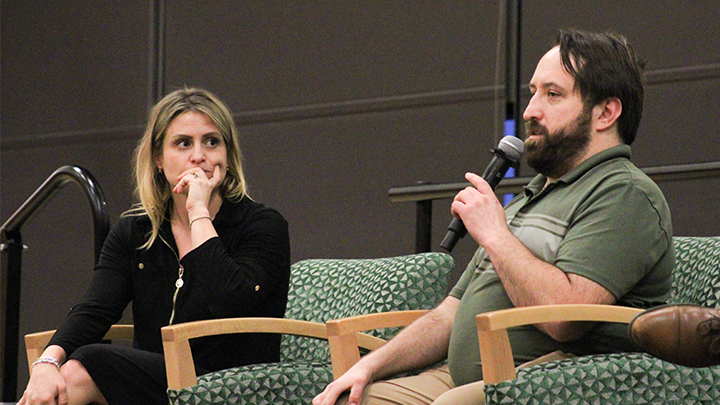
After debuting earlier this year following three years of production, “A Murder in Mercer” showed at SRU on Sept. 17 before an audience of more than 500 students, faculty, staff and community members.
“I truly love telling stories, mentoring students and helping young people find their own voice,” Fleming said. “But I also think it’s important that students see me doing the work I’m asking them to do. If I’m expecting them to work hard, take risks and keep learning, they should see me doing those things, too.”
Teaching and Research into Practice
Much of this process included application of topics Fleming teaches. Her courses center around multimedia journalism and digital media production.
“Of everything I’ve done in my career, this has been the most rewarding because it brought so much of my work together, and my students got to be a part of it,” Fleming said. “I was able to put years of teaching, research and production into practice, and now I can bring this experience back into the classroom and my research.”
During production of the documentary, Fleming recalled several principles she carries into teaching, such as building trust with sources, interviewing and storytelling.
“The first year was about earning people’s trust,” Fleming said. “Once we had that trust, we could get the interviews. Once we had the interviews, we had a story. More importantly, it gave the people who lived through it a chance to be heard in their own words and, in some cases, find a sense of healing.”
Fleming serves as an example of SRU faculty continuing to learn and contribute to their fields and using that application to keep their classes innovative.
“There’s a difference between teaching best practices and having lived them,” Fleming said. “When I talk about verification, interviewing, ethics or building trust with sources, I can show students what those decisions look like in the real world, and why they matter.”
Career Path for Cressman
Cressman, a non-traditional student who earned his degree in strategic communication and media, spent a few years trying to figure out what he wanted to do for a career before landing on documentary filmmaking.
“You’re always thinking to yourself, ‘One day I’m going to do it,’ but unless you actually go to do it, you’re never going to do it,” Cressman said. “Now that this is all over, I get to think, ‘You know what, I actually did it.’”
During his time at SRU, Cressman took classes instructed by Fleming and served in multiple leadership positions in student media organizations she advises.
“I remember the first time she brought it up,” Cressman said. “It was an opportunity to work on something we both enjoy and for me as a student to take what I learned in her classes and other classes and put it to work.”
Student Involvement
Fleming brought two students into the production process as well: August Jones, a senior strategic communication major from Eldersburg, Maryland (Century HS); and Colby Gray, a senior strategic communication and media major from Waynesburg (West Greene HS).
“There were so many things throughout this process that I was doing for the first time, and I couldn’t imagine not bringing my students along for the experience,” Fleming said. “I want them to have opportunities to do real work, take on challenges and build confidence in what they’re capable of doing.”
Along with assisting production, the students were able to develop several of their own professionally focused skills.
“(It was about) taking the time and getting to know your subject, not just for the sake of entertainment but for the fact of getting the right perspective and telling the most truthful story that you can,” Jones said. “It’s really opened my eyes to sensationalized media and being cognizant of who it could impact in the long run.”
“SRU prepared me in every way because I didn’t know anything about media before I came here,” Gray said. “It is super motivating, just seeing documentary production actually happen versus being told how it happens.”
Educational Resource
In addition to screening the film at the 2026 College Media Association/Associate Collegiate Press convention in November, Fleming, Jones and Gray will deliver presentations on ethics in true crime storytelling.
“One of my long-term goals is for the documentary to become an educational resource for universities,” Fleming said. “We’re developing materials that can help faculty use the film to start conversations about journalism, documentary production, media ethics and responsible true-crime storytelling.”
Growing Audience
The reception for “A Murder in Mercer” goes well beyond SRU’s campus. The film was screened before hundreds of people in Indiana and Armstrong counties with additional screenings planned in Mercer County, at Indiana University of Pennsylvania and the University of Pittsburgh later this year. Also, the film was accepted into several film festivals, including the McDonough Storytellers Film Festival in McDonough, Georgia, and the Oil Valley Film Festival in Pennsylvania earlier this summer, as well as the Red Rose Film Festival that will take place in Lancaster in November.
More information about the strategic communication and media major is available on the program’s webpage. More information about “Murder in Mercer” is available on the documentary’s website.