

Slippery Rock University is where faculty, students and alumni collaborate on engaging research across disciplines and advance greater understanding of their professional practice.
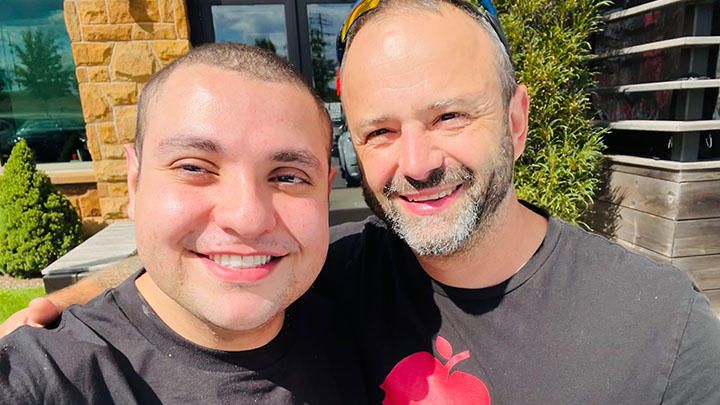
Mohamad Khalaifa, ’23, ’25M, wrote an illuminating paper on post-COVID teacher burnout alongside Jason Hilton, professor of curriculum, instruction and educational leadership.
The article, “‘My teaching job is not what it used to be, and I’m looking for a way out:’ A Mixed-Methods Examination of Teacher Stress Levels Following the COVID-19 Pandemic” was published in the Journal of Teaching and Learning, one of the foremost publications in the field of education.
Khalaifa, who graduated from SRU with a master’s degree in data analytics and a bachelor’s degree in psychology, is now pursuing a Ph.D. in clinical psychology at Bowling Green State University.
“As a lifespan psychologist, my training is in both adult and child psychology,” Khalaifa said. “So, I’m really interested in schools and how what goes on inside of schools manifests outside.”
This interest led Khalaifa to ask questions about the ways in which the COVID-19 pandemic exacerbated teacher stressors and how teachers and schools should respond to these complicating factors.
“One thing Dr. Hilton and I identified as important in our paper was the continuation of administrative support from principals and superintendents,” Khalaifa said. “This plays a really vital role in teachers’ personal feelings of being valued and understood as issues occur. Teachers are trying their best, so understanding the role of administrative support to mitigate burnout is important.”
The importance of this work, according to Khalaifa, lies as much in student outcomes as it lies in the workplace happiness of teachers.
“Teachers play a long-term role in the lives of their students,” Khalaifa said. “In fact, research shows that positive relationships between teachers and students have substantial benefits for students, especially those from underprivileged backgrounds. Those relationships can really impact student test scores, attendance and emotional development. We want to see teachers’ needs being met so they’re prepared to give their students the best education possible.”
Khalaifa’s own experiences at SRU speak to the importance of educators’ roles in students’ lives. Khalaifa feels that his mentors played a vital role in preparing him to begin his career and doctoral studies.
“I actually started this research with Dr. Hilton while I was still an undergrad, and we’ve continued it since I’ve graduated,” Khalaifa said. “Working with him for years has really impacted me as an academic, as a researcher and as a human being. When I started at SRU, I wasn’t sure what I was going to do, and Dr. Hilton sat with me and helped me to create a plan and to develop and understand my needs. He was very helpful as a crucial time in my life.”
This commitment to research and mentorship that was modeled nurtured for Khalaifa at SRU has instilled in him the desire to pay it forward.
“As a prospective professor, I do hope to give my future students the guidance my professors gave me, and in a clinical setting, I try to see the best in people in their own crucial moments. My mentors at SRU have provided me with skills that I’ll need to help my clients, kids I work with in schools and my future students.”
More information about psychology and data analytics at SRU is available on their program webpages.