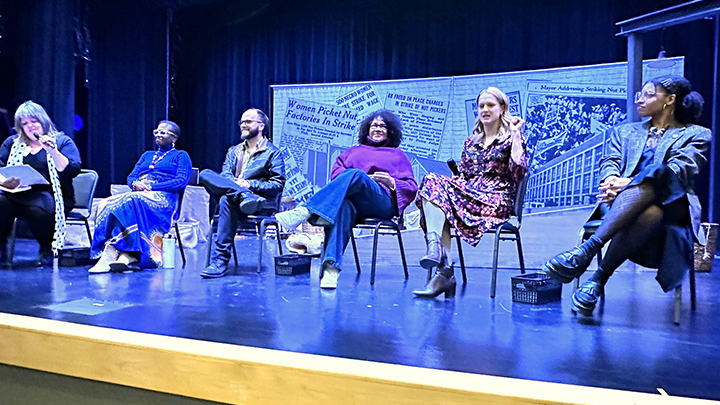


Survival, resilience and remembrance were at the heart of a powerful gathering at Slippery Rock University, where students, faculty, staff and community members came together March 11 for the University’s Holocaust Remembrance Program in the Performing Arts Center’s Miller Theater. The event served as both a moment of reflection and a testament to the strength of a supportive community committed to honoring history and preserving the voices of those who lived it.
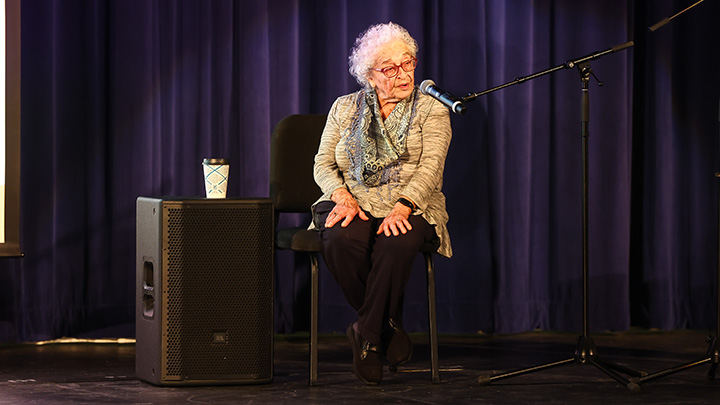
The evening opened with a performance by SRU musicians that created a thoughtful atmosphere that prepared the audience for the program’s central moment — the live testimony of Holocaust survivor Erika Taubner Gold.
Born in 1932 in Budapest, Hungary, Gold was a child when the Holocaust swept across Europe during World War II. Her story is one of courage in the face of unimaginable hardship, and her presence offered the SRU community a rare and meaningful opportunity to hear history directly from someone who lived through it.
Gold grew up in a Jewish family that was active in their community, attending synagogue regularly while her father operated a haberdashery inherited from his family.
As World War II spread across Europe, Hungary allied with Nazi Germany and conditions for Jews deteriorated. After the German occupation of Hungary in March 1944, anti-Jewish restrictions intensified. Gold was forced to stop attending school, the family business was confiscated, and they were required to wear the Star of David. Her father was repeatedly taken for forced labor, and Gold and her mother were eventually forced from their home into crowded Jewish housing.
Later that year, Gold and her mother avoided deportation by working in a uniform factory. When authorities attempted to remove the workers, the two escaped and hid in Budapest with their former housekeeper, Ilonka Takats. They remained in hiding until January 1945, when Soviet forces liberated the city. Gold’s father survived the Budapest ghetto and reunited with them the same day.
Although the family survived, they later learned that 44 relatives had been killed, many at Auschwitz concentration camp. Seeking a new beginning after the war, the Taubners immigrated to the United States in 1950 and settled in Cleveland, where Gold later built a career as a medical technologist and raised a family.
Watch a video excerpt from Gold’s presentation here: