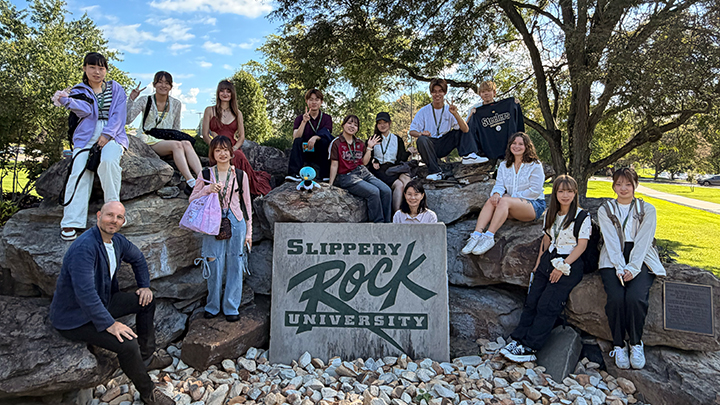
Behind Slippery Rock University’s decade-long partnership with Saga University in Japan is Yukako Ishimaru, an SRU instructor of languages, literatures, cultures, and writing. Ishimaru is a catalyst for the SRU’s Cultural Immersion Program through which the University hosted 10 students from Saga for a brief, but impactful stay in Slippery Rock, Sept. 10-19.
Since 2013, SRU has partnered with Saga, supporting more than 300 students looking to study abroad and expand their horizons, both academically and personally.
“I graduated from Saga University, and after I started teaching at SRU, I wanted to have a connection between both universities,” Ishimaru said. “I wanted to connect my hometowns.”
Recognizing that extended travel is not feasible for every student, Ishimaru helped develop a short-term alternative.
“Not everyone has the luxury to do a long-term study abroad program, so we explored an option to see if we could establish something like a mini-abroad experience for our students,” Ishimaru said.
This idea snowballed into what is currently known on campus as the Cultural Immersion Program. The program emphasizes immersive cultural understanding and practical language engagement over traditional classroom repetition, an approach that stands in contrast to typical English education in Japan.
“[The students from Saga] are here to study English,” Ishimaru said. “In Japan, it’s a compulsory subject, but their teaching style is different. Teachers don’t speak fluent English and are more focused on grammar and accuracy, which prevents them from using language communicatively. So, we wanted to push them out of their comfort zones and encourage them to use English to communicate and thrive.”
Students from Saga had the opportunity to attend classes with enrolled students and engage with all facets of SRU’s campus community, but the largest impact for these students was found within their host families.
While local community members initially provided housing, the program has shifted toward a reciprocal model where former study abroad participants at SRU host visiting international students. Many of the SRU hosts were students who had traveled to Saga the previous last year.
“The real experience comes around with the host families,” Ishimaru said. “A lot of these students have had the experience of serving as conversation partners, so there are a lot of intertwined relationships among themselves.”
Through this arrangement, many Saga students were able to spend their stay in Slippery Rock alongside friends they made during their own time hosting.
Ishimaru noted that while the primary goal was language instruction, the social and personal impact on students from both institutions has been the most rewarding outcome.
“It’s such an interesting phenomenon because I thought that I was just teaching the content, which is language, right? But it’s really about their personal growth,” Ishimaru said.
For SRU students, particularly those studying Japanese, the program offers a sense of belonging that extends beyond the classroom.
“Watching these students grow, who I’ve come to view as my own children, is one of the most fascinating parts of the program,” Ishimaru said. “A lot of students in my SRU Japanese program start out feeling a bit reserved or hesitant. Some struggle with a sense of belonging or feel a little isolated, but once they step into this class, they mingle with peers and Saga students and create their own sense of community.”
More information about the modern languages and cultures program at SRU can be found on the program’s webpage. More information about study abroad programs at SRU is available on the University’s website or by calling 724.738.2057.