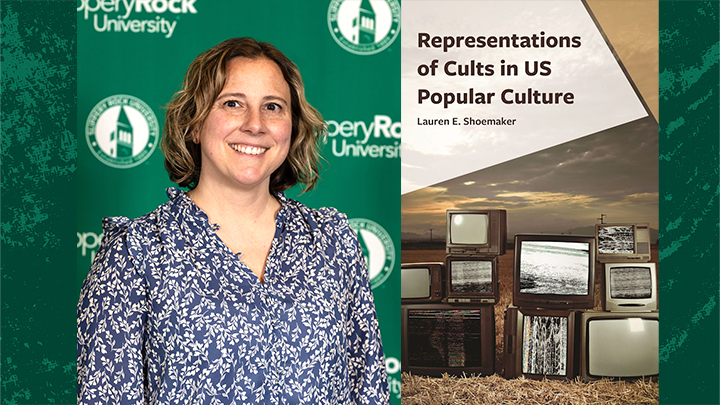
After years of research and dedication, Lauren Shoemaker’s scholarly work is finally taking shape in a new book. Shoemaker, a Slippery Rock University associate professor of languages, literatures, cultures, and writing, wrote a book “Representation of Cults in US Popular Culture,” that will soon be released.
The book analyzes the representation of cults in American popular culture, arguing that portrayals of cults play a role in both generating harmful stereotypes and examining structures of power that uphold oppressive systems.
Shoemaker has a different perspective on cults than most researchers.
“I know that people who study cults are going to be like, ‘Wow, you are pro-cult. That’s so dangerous, that’s so awful,’” Shoemaker said. “But I think, it’s not necessarily being pro-cult. It’s being pro-human rights.
“People forget that we do have religious freedom in this country, and that means that people can have their cults. We cannot assume that we have moral authority over other people and how they choose to worship.”
The Beginning
Shoemaker became interested in cults early in her career when researching Caribbean novels. She came across retellings of the 1978 Jonestown mass death event in Guyana led by religious leader Jim Jones.
“Reading about it in different contexts and how people reimagine Jonestown is as interesting than the actual story of Jonestown,” Shoemaker said. “Because so many of Jones’ followers were African American women, and they were older, and that gets left out of the story entirely. Putting Jonestown in that context of a long story of colonialism, a story of global anti-Blackness, is really important.”
Women in Cults
The fourth chapter of Shoemaker’s book discusses the representation of cults in comedy, especially the TV show “The Unbreakable Kimmy Schmidt,” a sitcom that aired in the mid 2010s that follows a fictional story about a woman who adjusts to life after being rescued from a doomsday cult.
“Sexual violence affects a larger number of people than cults, but the cult is where it happens to Kimmy,” said Shoemaker, who is co-director of the gender studies program at SRU. “And only when sexual violence happens to Kimmy outside of the cult is she able to think about and heal from the cult experiences she had.”
Shoemaker rejects the idea that sexual violence is more prevalent in cults, claiming that cults don’t participate in sexual abuse or sexual violence at any higher of a rate than any other religion.
She hopes that what people take away from this section of the book “is a pervasiveness of patriarchy and sexual violence and systems that take advantage of vulnerable women, and not just within cults.”
Matter of Free Will
Based on the research presented in her book, Shoemaker believes that the actions and beliefs of cults should be compared to other systems and cults have the potential to be admirable.
“What are we willing to risk in envisioning what our culture could look like otherwise?” Shoemaker asked. “Recognizing that a lot of people suffer under capitalism and Christian religion right now, and the fact that some people are even willing to step outside that and see what else is out there as a possibility, to me, is really inspiring and I’ll defend their right to do so.”
More information about Shoemaker’s book and how to pre-order a copy is available on the publisher Bloomsbury’s website.