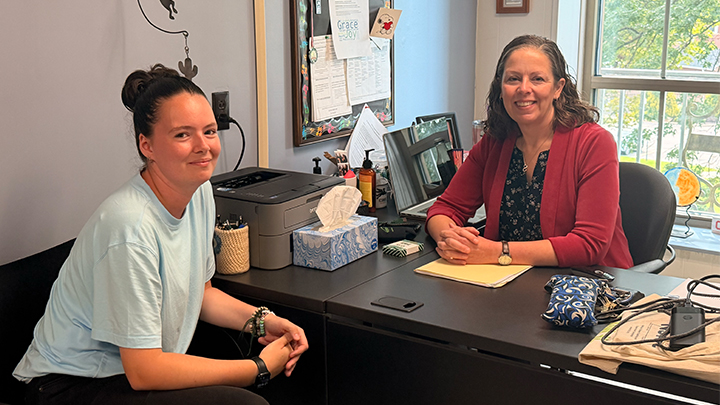
A Slippery Rock University student is helping future teachers build a stronger start to their academic and professional careers by using music. Tilly McLaughlin, a junior music education major from Lafayette Hill (Plymouth-Whitemarsh HS), along with Kathleen Melago, professor of curriculum, instruction, and educational leadership, are conducting research at SRU to build identity, belonging and agency for teacher candidates.
“Our goal is to help students, from the moment they walk into their first day of college, to start to think about their teaching career,” McLaughlin said. “One way to do that is through music.”
McLaughlin is providing future educators with useful frameworks for their classrooms, ones that are built on establishing identities, belonging and agency within their students, as well as themselves.
Finding Meaning in Music
With this project, McLaughlin and Melago’s goal was to find and select songs that students could recognize in the classroom and be able to connect to while actively developing as teachers. When collecting data, McLaughlin selected popular songs across various genres and then conducted lyrical analysis to find a connection to teacher development and social emotional learning.
After establishing the songs and what area of teacher development they connected to, McLaughlin then developed lesson ideas for each of them. These lessons ranged from personal reflections, small and large group discussions, role playing scenarios, and creating presentations.
“I picked about 30 to 40 songs, anywhere from pop, rock, R&B, funk, soul, spanning across a bunch of different genres and eras,” McLaughlin said. “Then, I broke down those songs and said, ‘OK, if you look at a song, if you look at the lyric, if you look at the message behind it, if you look at the time it was written, what message can you take from the songs to inspire collegiate students to build their identities as teachers? How could these songs impact future students in the classroom?’”
The outcome of the project will be a completed digital and print resource that holds 30 lesson plans featuring 30 songs about teacher development, focusing on how music can be used to help the development of all teachers, not just the development of future music educators.
In order to help current education students better understand themselves and recognize the backgrounds of their future students, music as a pedagogical tool can open new avenues for self-reflection and connection.
“The use of music as a pedagogical tool will benefit both the teachers and their students,” McLaughlin said. “With the teachers, allowing them to work through these lessons before they are in front of students will help to bring them more perspective as they prepare to support students in the classroom. Teacher development is something that takes time to develop and continues developing as students graduate from college and start their careers.”
Building Stronger Teacher Identities
This sentiment from McLaughlin identifies a very common issue among education majors. Many do not feel established in their own identities as educators when first breaking into the workforce. McLaughlin and Melago’s research empowers future teachers, giving them a greater opportunity for development early on.
“Allowing the space for this development to start in the classroom will benefit future teachers as they begin field placements and move into student teaching,” McLaughlin said. “When teachers are more concrete in their teacher identity, it allows them to be able to better support their students in more ways than just academics, including allowing them to support their students as people.”
Melago first approached McLaughlin to carry out this project during the Spring 2026 semester, but it initially started as an idea during March 2020. Melago sought to combine her work done in music education and social emotional learning with teacher education.
“I got this idea that we could use music in teacher education classes to create identity, belonging, and agency in the preparation process,” Melago said. “Students have to start thinking, ‘If I’m going to be a teacher, what does that look like as a part of my identity? What does it mean to belong to a community of teachers, and how do you create belonging in your classroom with your students?’”
Personal Impact of Research
McLaughlin and Melago’s project is funded by SRU’s Summer Collaborative Research Experience Grant. SCORE grants provide opportunities over the summer for undergraduate students to explore the world of academic research in collaboration with faculty members in their respective areas of study.
McLaughlin’s experience working alongside Melago has been beneficial for her development as a professional, providing her with first-hand experience diving directly into research opportunities, while also laying the groundwork for her future as an educator.
“I did not see myself getting into research this early,” McLaughlin said. “I’ve had a lot of teaching opportunities, and I’ve been starting field experience as well, so getting to do this research at the same time has allowed to look at teaching and then apply what I’ve learned right away. I have a stronger view on what trends are actively going on.
“This has given me the advantage of being able to step back and look at teaching through psychology trends, and it gives me another lens to see through.”
McLaughlin will present her research at the Pennsylvania Music Educators Association conference, April 14-17 in Erie.
More information about music education at SRU is available on the program’s webpage. Explore all education programs on the SRU website. More information about SCORE grants are available on the SRU’s website.