

What began as a father’s determination to help his young son navigate Duchenne Muscular Dystrophy has evolved into groundbreaking research that could change how the condition is treated. Jon Anning, a Slippery Rock University associate professor of exercise science, has developed a comprehensive framework for understanding the historically controversial role of exercise in the treatment of Duchenne Muscular Dystrophy, a genetic disorder known as DMD that causes progressive muscle weakness and degeneration, leading to loss of mobility over time.
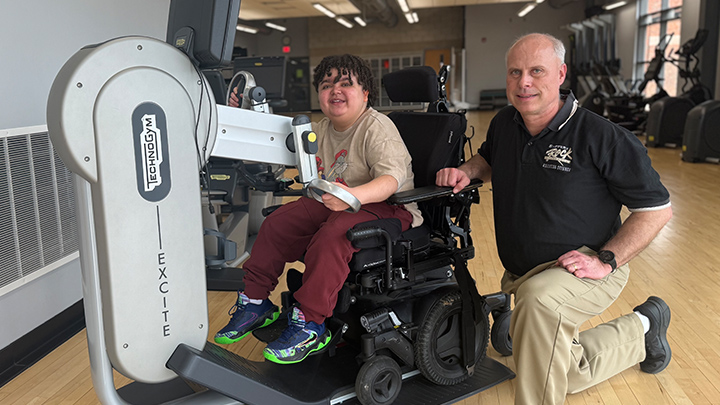
The genesis of this research stretches back to the early childhood of Anning’s now 16-year-old son, Matthew, a sophomore at Slippery Rock Area High School.
“When Matthew was diagnosed at 4 years old, we heard about all of these clinical trials and things that he could get involved with,” Anning said. “I wanted to help him, so I asked for the data on those trials.”
Anning was told that he couldn’t have that data as it was all part of a research study. This led Anning to begin his own treatment proposal centering exercise as a treatment strategy for DMD. Anning’s curiosity led him to collaborate with researchers at the University of Pittsburgh to find ways to implement exercise without causing damage.
One of the complications of DMD is that, once damaged, muscle doesn’t regenerate, making the type and intensity of specific exercises crucial to help a patient rather than cause quicker loss of physical capacity.
“We started looking at all of the medicines that patients with DMD are given and all of the side effects, and we found that exercise can counteract those effects,” Anning said.
Anning’s first article, published in Professionalization of Exercise Physiology Online in 2022, focused on advocacy for exercise. He then turned his attention to which exercises would be appropriate for all five stages of DMD. His most recent article was published in the Journal of Rehabilitation Practices and Research.
“We wanted it to be readable for practitioners and caregivers so that everyone could get some new perspectives on how to approach exercise and DMD,” Anning said. “We’ve gone to physical therapists with Matthew who haven’t been aware of what they can and can’t do, so it’s just as important to practitioners as it is to caregivers.”
All of Anning’s work on this project has been done to help his son and the DMD community at large. Anning described the DMD community as “tight knit” with parents, researchers and individuals living with the condition connecting with and supporting one another.
Anning himself served as a parent professional representative of the DMD community at the UPMC Children’s Hospital of Pittsburgh’s Family and Medical Advocacy and Advisory Committee from 2020-21.
With his deep understanding of DMD from both a parent and a researcher’s perspective, Anning is helping to push the conversation around the treatment of DMD as well as the treatment of young people living with this condition. His son is a typical teenage boy who loves sports and video games and is incredibly social and outgoing. Matthew is involved in his high school’s “Sports Talk” club where he is learning how to be a sports broadcaster. He is heavily involved in an esports league with other young people living with DMD and other physical disabilities in the Pittsburgh area.
“The main thing is understanding what you’re having them do,” Anning said, speaking of DMD patients at-large before homing in on Matthew’s experiences. “He wants to participate in all activities, so it’s important to be creative in how you accomplish that. The important part is treating them like every other kid but being smart about how you get that done.”