

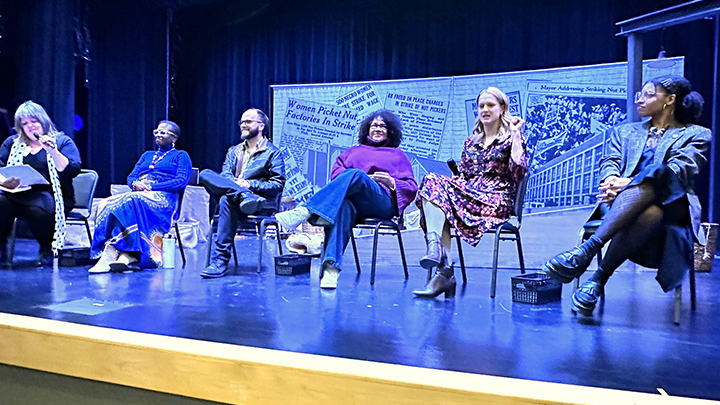

A Slippery Rock University history faculty member’s work has inspired a creative new production in her home state of Missouri. A 2022 book written by SRU associate professor Melissa Ford was adapted into the play “A Brick and a Bible” by Bread and Roses, a St. Louis based nonprofit organization that connects activism and the arts, giving voice to the histories and current realities of the working class in the Midwest.
“As a historian, we deal with paper; we don’t see things in 3D,” Ford said. “But to see it that way with these artists presenting their own interpretation was incredibly powerful.”
The play was performed for 10 shows in three locations in the St. Louis area, Feb. 19 to March 8, including the Missouri History Museum and the Metro Theater Company.The book, also titled “A Brick and a Bible,” stemmed from Ford’s dissertation for her doctorate.
Ford researched the social, political and economic activity in St. Louis in the 1930s. What she found was a story of 1,000 Black women workers operating under deplorable conditions for paltry pay in the R.E. Funsten Company’s pecan-processing plant. These women, led by factory worker Carrie Smith, forged an unlikely alliance with the local Communist Party, and carried out a successful strike for better pay, better working conditions and union recognition, winning all of their demands.
“There is a new train of scholarship to center Midwestern history as urban history, and particularly as Black urban history,” Ford said. “So, I think it’s important to reframe Midwestern history to show these real sites of social and political activism and to show Black women leading the way.”
For Ford, scholarship doubles as allyship. As a white scholar who speaks, teaches and writes about Black history, Ford seeks to shine light on the voices and stories of Black Americans and the vital roles that they have played in U.S. history.
“We usually think of ‘ally’ as a purely activist term, but I also think it’s an academic term,” Ford said. “It’s important to me to be an ally for these marginalized histories and marginalized people. As a scholar of the histories of groups that you’re not a member of, your job isn’t to speak for that group, it’s to amplify their voice or their story.”
This amplification of these histories was taken to a new level when Bread and Roses stepped in, adapting Ford’s book into a story about a young Black woman finding her voice amidst the events of the Funsten Nut Strike.
History coming alive in this way is in line with Ford’s own values as a historian, particularly pertaining to her work surrounding the Great Depression. This story, written on paper, becomes 3D in the play, and an era defined by stagnancy and resignation is shown in a new light that reveals the vitality beneath the struggle.
“I think in studying the Great Depression, it’s incredibly important to remind people that this wasn’t a period of just desperate people standing in bread lines and waiting for help,” Ford said. “It’s defined by anger, agitation, motivation and agency in ways that are incredibly inspiring.”
More information about Bread and Roses is available on the organization’s website. More information about Ford’s book is available on the publisher’s website.