

Marnie Jo Petray reached one of the highest accomplishments for scholars in the humanities: authoring a book.
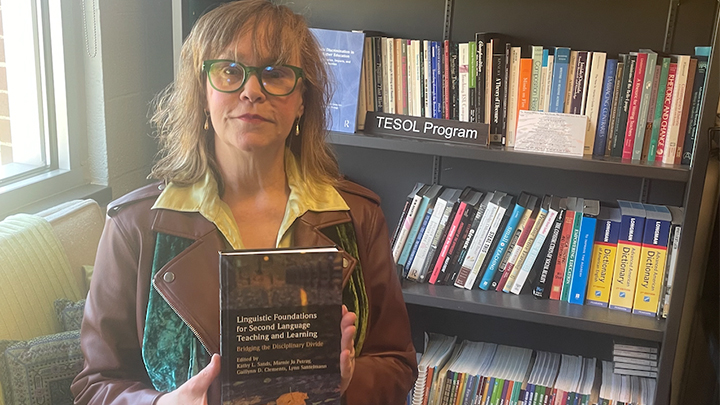
Petray, a Slippery Rock University associate professor of languages, literatures, cultures, and writing, culminated a decade of cooperative scholarship with the publishing of a co-authored book that offers a model for the merging of the theoretical and applied branches of linguistics.
Her book, titled “Linguistic Foundations for Second Language Teaching and Learning: Bridging the Disciplinary Divide,” was written in collaboration with independent scholar Kathy Sands, Gaillynn Clements of Duke University, and Lynn Santelmann of Portland State University and published by Cambridge University Press. At SRU, Petray is the coordinator behind the TESOL master’s program, short for Teaching English Speakers of Other Languages, an important program that is rooted in the applied linguistic discipline of the teaching and learning of second languages. Petray’s interest in increasing the effectiveness of language teaching served as a natural entry point for this project.
“There is a strange, almost inexplicable dissonance between theoretical and applied linguistics,” Petray explained. “The folks who study second language teaching and learning have not always tapped into linguistic theory, and the theoretical linguists haven’t always considered as much second language learning data as they should have. So, this book is an effort to join those two endeavors and to push for their integration.”
In an increasingly global society, efforts to support second language learning are critical in educational and career contexts.
“Multilingualism and bilingualism are things that students should be thinking about in terms of their professional futures,” Petray said. “In your career, the odds of you interacting with someone from a different language group are high.”
Petray argues that this ability to communicate across these linguistic and cultural gaps not only makes one more employable but also enriches them personally.
On philosophical and practical levels, Petray’s work is about communication that fosters collaboration.
“The purpose behind connecting theoretical and applied linguistics was to open doors to say, ‘Look, this should be reconsidered, because it’s really important.’ We miss a lot of information this way,” Petray said.
This is also a thread that attaches Petray’s other research interests to her work on this book. As a scholar of linguistic discrimination, Petray also studies the biases that individuals experience based on the dialects, languages and accents.
“I’m interested in diversity, and I’ve always been interested in the ways that language interacts with human endeavors,” Petray said. “So, this is another way of expressing that, because teaching and learning a second language is a human endeavor.”
Through both her research and her work in the classroom, Petray is building bridges between communities and ideas that may feel worlds apart in the interest of progress, collaboration and a more connected world.
More information about the book is available on the Cambridge Press website.