
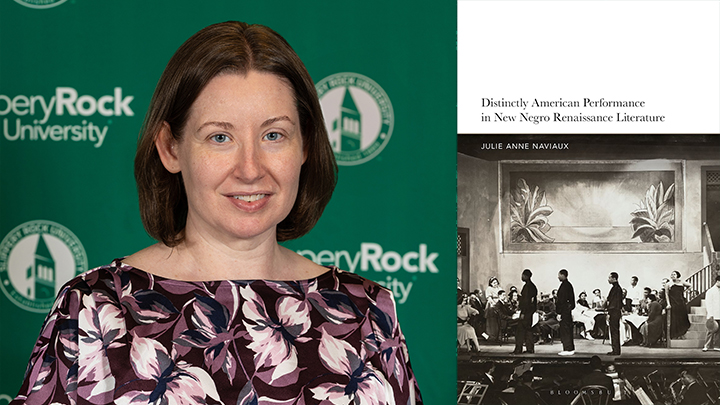
A Slippery Rock University faculty member is shaping conversations and advancing knowledge beyond the classroom about the history of Black art, both in literature and in performance. Julie Naviaux, an SRU associate professor of languages, literatures, cultures and writing, authored a book, titled “Distinctly American Performance in New Negro Renaissance Literature,” that will be released in December.
“People like to view the hard parts of history as things that are just neatly in the past.” Naviaux said. “However, people like to think they don’t impact what happens in our world or impact our views.
“I want people to understand, if we exist in a society like America, we cannot escape the legacy, the background, the society in which we exist. I can do my best to educate myself, to train myself, to teach myself, to do better, but I can’t escape entirely.”
New Negro Renaissance
To describe the national movement of Black music, dance, art, fashion, literature, theater, politics, and scholarship in the 1920s and 1930s, Naviaux chose to use the term “New Negro Renaissance” instead of the more commonly used “Harlem Renaissance” because this movement is actually much larger than just Northern cities like New York.
She also explained that the word “Negro,” which now carries a negative connotation, was used to recognize its significance in the movement at the time.
“It rejected the word colored, which was the mainstream American accepted word of Black people,” Naviaux said. “The leaders of the Renaissance argue that instead using Negro with a capital ‘N’ is a way of embracing racial pride and a rejection of all the prejudices and assumptions that come with the word ‘color.’”
Influence through Theater
Naviaux explained how Black Americans created their own forms of art and entertainment when they were prevented from mainstream forms of art.
“In one example, pre-Civil War, Black Americans, as a form of entertainment, would dress up in ways they saw high-class, aristocratic white people dress and would make fun of them,” Naviaux said, “by exaggerating their mannerisms, by over-emphasizing styles of dance and dress. This was called ‘cakewalking’ because if you ‘walked’ the best, you would win the cake.
“White people did not understand that the Black performers were making fun of them. They thought it was the Black performers actually trying to perform upper-class whiteness.”
She explained how this lack of understanding led to the beginning of blackface.
“White performers darkened their faces and over-emphasized racist ideas about what Black people looked like, and then the white performers would perform like the Black performers had been performing as the white elite.”
Later, Black performers recognized the opportunity to make money in this and began performing similar routines themselves.
“And there was a lot of money in this,” Naviaux emphasized. “It was a huge industry across the U.S. This led to later opportunities through Vaudeville and minstrelsy.”
Examples in Literature
Naviaux explained how Black writers at the time would attend these shows and incorporate their interpretations and thoughts into the literature.
“You start to get these moments where the narrator goes to one of these shows, and they talk about what they see in the show, and they talk about the audience’s reactions to the show,” Naviaux said. “They divide the reactions between what white audiences react to, what they find funny, what they accept as authentic and then they separate how Black audiences respond.”
Two examples of this form of literature are “Colorstruck,” a play by Zora Neale Hurston that takes place at a cakewalking competition, and “Autobiography of an Ex-Colored Man,” a fictional novel by James Weldon Johnson about a Black pianist.
American and African American
Naviaux’s book analyzes “the problematic nature of being both American and African American,” or the idea that Black Americans are never considered truly American. Naviaux explained this concept using the novel “There is Confusion” by Jesse Fauset, and the character of a Black dancer named Joanna.
“At the end of the book, Joanna performs for a major Broadway show as ‘America,’” Naviaux said. “She performs as just America, and she performs as colored America. For the colored America role, she just is herself, a Black dancer. For the America role, she has to wear a white mask. Even though it’s not the white America role, it’s just America.”
Naviaux explained how this concept carries through to the present day, using Kanye West’s support for U.S. President Donald Trump as an example.
“During President Trump’s first election, Kanye was a really big supporter,”
Naviaux said. “Then when the president was elected, there’s always the inaugural celebration. President Trumps’s representatives were asked, ‘Will Kanye West perform at the inauguration?’ and the representatives said that Kanye was not ‘typically American’ enough to perform.”
Expanding Interest
Naviaux acknowledges that the topics she researches can be foreign and confusing to readers, but she encourages them to start learning.
“If something interests you, you don’t have to be an expert right away,” Naviaux said. “If you just start reading, if something seems interesting to you, and you just go and start learning about it, it can really open up a different part of the world you didn’t really consider before.”
More information about Naviaux’s book and how to pre-order a copy is available on the publisher Bloomsbury’s website.