

At a time when many colleges and universities across the nation are confronting enrollment declines and uncertainty, Slippery Rock University continues to demonstrate that strategic investment in student success produces measurable results.
- Undergraduate enrollment is up 3.4%, the largest single-year increase in 20 years.
- The first-year class is the largest cohort at SRU since 2019.
- 86.4% of the first-year students from last fall returned this year, which is the highest retention rate in the State System in the last decade and an SRU record.
- 58.3% of undergraduates are graduating in four years, which is the highest graduation rate in the State System in the last 20 years.
- Among State System schools in western Pennsylvania, SRU has the highest 3-year and 10-year percentages of graduates who are employed in Pennsylvania and the highest mean salary for bachelor’s degree recipients.
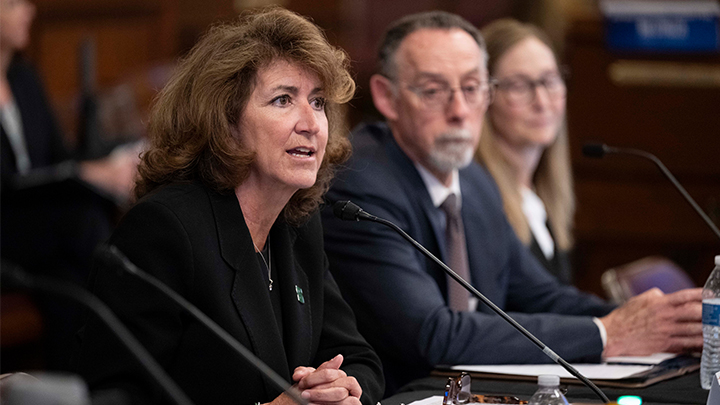
There’s no secret to SRU’s success. Take President Karen Riley’s word for it as she gave a testimony before the Pennsylvania House of Representatives’ Appropriations Committee on March 11 at the State Capitol in Harrisburg. Riley highlighted SRU’s strong performance and growing momentum, underscoring the value of continued investment in Pennsylvania’s State System of Higher Education.
Here are summarized remarks from her testimony:
Meeting workforce needs; Preparing students for in-demand careers
We are moving at the pace of industry rather than at the historic pace of higher education, so we added three new programs last year. We added construction management, we added electrical engineering, which filled out our entire engineering suite, and then we added another pathway for nursing.
When we look at those three programs alone, the applications total almost 400. Had we not added those programs and added them quickly, we actually would be down in overall applications.
We have to be nimble, we have to be quick, and we have to make sure that we are offering the programs [necessary for] a contemporary array for workforce development.
Empowering non-traditional students in the face of the birth bust
We created the third arm of our academic enterprise. We have undergraduate programs, we have graduate programs, and then we have certificates, micro-credentials, professional development, and stackables. The goal here is threefold –– new programs, new partnerships, and new approaches.
We have to be partnering with industry so that people actually know what is available to them and how they can access it. It has to be delivered in a way that makes sense to them and in times that make sense to them.
With the demographic cliff, what we haven’t heard is that people will stop learning, quite the contrary. People’s jobs will not be more static. In fact, they will be much more fluid in the future. We have to be nimble, we have to be reactive to the market, and being in the community with our industry partners is one way that we’re really working to make sure that options are available to them and that they are aware of them.
Supporting students beyond the traditional financial aid sources
Although we are public institutions, some of what we’re learning is that we need to act a little bit more like the (private schools) and up our philanthropy game. Slippery Rock, in particular, is working very, very hard on that.
In the past, we’ve brought in about $2 million a year. We’ve made a big commitment to scholarships, and we’ve brought in about $27 million over the past two and a half years.
[We are committed] to funding our students, to making sure that they have the highest quality education at the lowest possible cost. It’s not only accessing the funds that [state appropriations] provide, it’s federal dollars as well as our own dollars and philanthropic dollars.
Employers shaping curriculum for experiential learning and successful careers
When we look at experiential learning opportunities, I think that across the State System, people are doing amazing things. We have a lot of students who are Pell eligible and first generation –– this is an access institution.
We don’t want our students to have to make a choice between an experiential learning activity and a job [that helps pay the bills while they are in college]. We don’t want practicums, internships and those kinds of things to be only activities of privilege. We want to make sure that we can break down a barrier that disallows people who don’t have funds to be able to access those kinds of activities.
We’re very excited about what we’re doing. We’re continually looking for ways to fund those kinds of activities.
Strengthening relationships with community colleges
We do a great job of making sure that their credits transfer –– 99% of the credits that come from community college at Slippery Rock are directly applied to their transcript.
But what we found as we listened to a student who said to us, ‘I love Slippery Rock, I loved [my community college], but I haven’t found my weekend friends.’ And so that really hit both [me and the community college president] and we said, ‘What are we going to do differently?’ Our intention is now not just around the mechanics of making sure that there are no barriers to transferring from any community college to Slippery Rock, but in particular, Butler County Community College, and taking on some very new initiatives, like bringing busses of students to social activities, like football games, like basketball games, like our Rock The Weekend events, so that those [transfer] students start to develop friendships at Slippery Rock.
When they get here, they’re hitting the ground running, not just inside the classroom, but outside the classroom.