
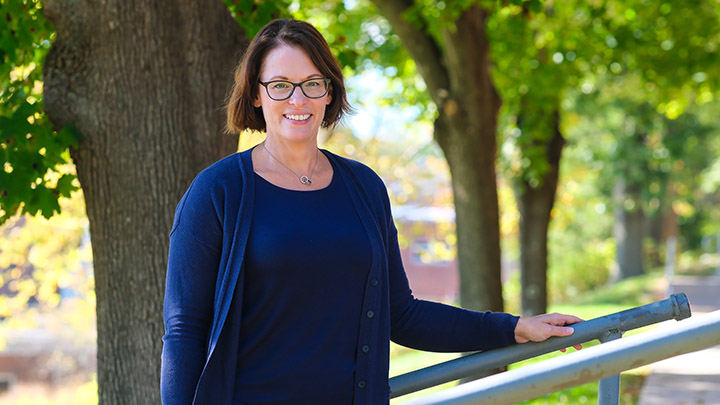

Through her distinguished work in grief education and support, Slippery Rock University faculty member Tami Micsky is elevating awareness and national standards in the field of thanatology, the study of death and dying. Micsky, an associate professor of social work, was recently recognized as a fellow in thanatology by the Association for Death Education and Counseling.
Micsky is at the forefront of a growing movement to expand people’s understandings of grief and loss and how to deal with emotions, whether it’s the loss of a family member, a friend or even a pet. People might process the oft-repeated stages of grief — denial, anger, bargaining, and the rest — or they would rather not think of death to begin with. Regardless of what it calls to mind, it is undeniable that grief and loss are painful topics that border on taboo. That’s why Micsky and other thanatologists are needed.
Micsky was promoted from a certificate holder in thanatology to a fellow in thanatology by the ADEC, an interdisciplinary organization comprised of psychologists, counselors, social workers, educators and more all seeking to promote excellence and diversity in death education, to provide information and resources around death and dying, and to facilitate the exchange of research around dying and bereavement. To achieve the level of fellow in thanatology, members of ADEC must practice at a consistent and high level with individuals and families who have experienced loss or teach courses and conduct and publish research in the field.
“The process served to really prove that I’m still learning and growing in my work and that I have something to offer,” said Micsky. “After doing that, I was granted the certification level of fellow.”
Micsky certainly does have something to offer in the field of thanatology. Her approach to the study of loss and grief is more expansive and inclusive than the usual application of thanatology.
“I don’t just talk about loss due to death,” Micsky said. “Loss can include things like disasters, divorce, a change of job, or any kind of change.”
The goal of Micsky’s work is to minimize the stigma associated with different kinds of loss, particularly to remove the notion that there is one “correct” way to grieve or that there are only certain things that it’s acceptable to grieve over.
“It helps to normalize that this is a universal experience, but it’s also very individualized,” said Micsky. “So those are the kinds of things that I try to get across in the classes that I teach, and the work that I do because that, to me, is the foundation of all of it.”
While thanatology as a discipline is the study of death and dying, it is growing in the direction of Micsky’s work. This came about in no small part due to COVID-19 and the massive social and psychological upheaval that the pandemic brought on.
“There were so many losses during that time, not just deaths, but people not getting to have graduations or weddings or other important life events and they weren’t necessarily given space to grieve,” said Micsky.
This, she believes, woke people up to the idea that loss has a broader definition than what was previously allowed.
Scholars like Micsky and organizations like ADEC push the public’s understanding of grief and loss, as well as practices for coping with these experiences. They are paving the way for a social revolution in which all forms of grief and loss are contended with and honored in the interest of a more open-minded and empathetic society.