
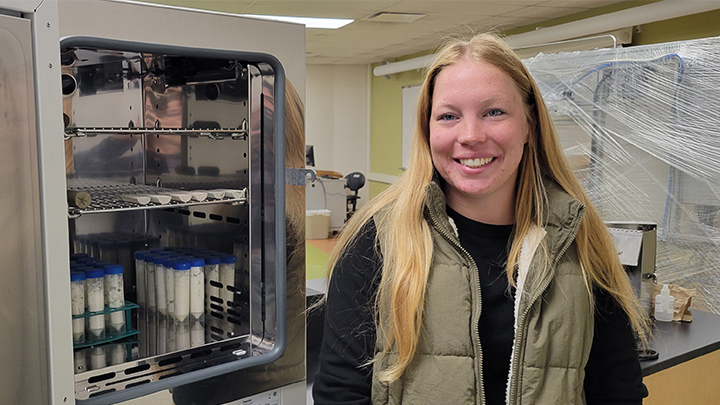

Allison Taylor is gaining valuable experience contributing to a faculty-led research project that tests how gas is stored underground.
Taylor, a Slippery Rock University senior petroleum and natural gas engineering major from Fremont, Ohio (Fremont-Ross HS), has spent the last two years researching under the guidance of Xindi Sun, assistant professor of engineering. They are testing how nanogels, which are tiny gel-like polymers that absorb and release materials, can be more efficient at storing gas in land reservoirs.
“I made 24 different samples with different chemical additives and different nanogel concentrations to see how those additives or different concentrations would affect the gelation time,” Taylor said.
The research was made possible by a grant Sun received as part of the American Chemical Society’s Petroleum Research Fund. The ACS Fund supports fundamental research in new, understudied projects in the oil and gas industry, particularly highlighting undergraduate student involvement. Other students involved with the research include James Josiah, a senior petroleum and natural gas engineering major from Sharon Hill.
Taylor’s extensive studies have given her career-supporting insight to carbon dioxide (CO2) flooding in the drilling industry.
CO2 flooding is a method used to maximize oil and gas output in drilling, simultaneously storing CO2 underground. When used in highly permeable sandstone reservoir locations, the process can be almost useless as the CO2 can break through too quickly.
The nanogel solution that Sun’s student researchers are testing would increase the efficiency of the process by blocking areas further from the injection well.
“The nanogel is supposed to plug downhole,” Taylor said. “If you want to store gas, you’re pumping CO2, and that’s not good for the environment, so you want to keep it downhole. The nanogel is able to get further into the reservoir than the previous gels used in drilling.”
Taylor has completed a drilling internship with the drilling company H&P, so her research on the completion side of the industry has rounded out her experiential knowledge of oil and gas drilling technology.
“I enjoy my career, and I want to keep learning and developing my knowledge by continuing the research,” she said. “The more I get into this industry, the more I want to learn grow as an engineer.”
More information about the engineering programs at SRU is available on the program’s website.