
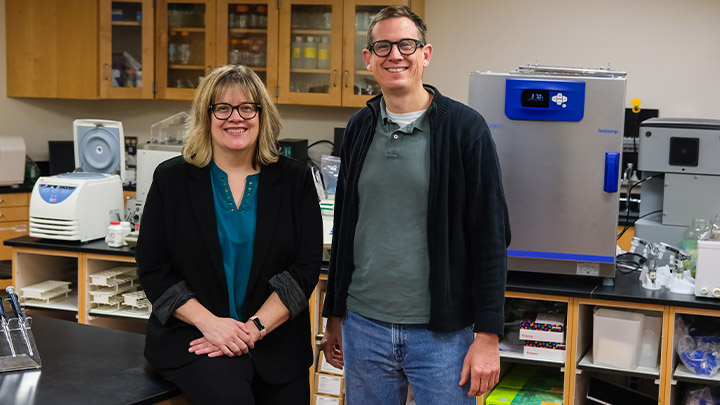

Five former Slippery Rock University biology students are celebrating their first peer-reviewed publication for work they did at SRU alongside faculty mentors Stacy Hrizo and Martin Buckley on a multi-year study of cellular stress responses. Hrizo and Buckley lead the team of researchers as they analyzed ways to reduce heat stress in organisms. Their work was published in the academic journal microPublication Biology.
“Hypothesis driven research gives students a chance to actually execute the experiments hands-on and on their own, using modern genetic and molecular approaches,” said Buckley, associate professor of biology. “You can lecture the theory but actually applying that knowledge to address an important biological question is crucial – it’s something unique that our Biology Department offers to students.”
The SRU-funded research examined how resveratrol, an antioxidant found in red wine, reduces heat stress in cells of Drosophila melanogaster, commonly known as fruit flies. The team found that while resveratrol reduces heat stress, it does not do so through the first stress-response pathway they examined – suggesting the compound works through a different cellular pathway.
Buckley and Hrizo said new collaborative research at SRU will build on the team’s findings to identify the pathway responsible for resveratrol’s positive effects. Using fruit flies as a widely accepted model organism and understanding how resveratrol reduces heat stress in fruit flies could inform findings across species, including human health, drug development, ecology and broader strategies for improving resilience to environmental stress.
“That’s how our research program grows,” said Hrizo, professor of biology and department chair. “There are other stress response pathways that we are researching now that may potentially explain the effects we see with resveratrol.”
The emphasis on hands-on, student-driven research benefits students enrolled in biology programs at SRU because their experience gives them a competitive advantage as they enter biology-related fields.
The five SRU graduates, all of whom earned their bachelor’s degrees in biology served as co-authors on the project, include:
- Nichole Webb, ’23.
- Riley Bricker, ’22.
- Tyra Skalos, ’23.
- Annette Choi, ’19.
- Austin Shirk, ’20.
“We see the students really invest in the research and learn from it,” Hrizo said. “That helps propel them forward in their career, do really well interviews and know that this is the field they really want to go into.”
More information about biology programs at SRU is available on the program’s webpage.