
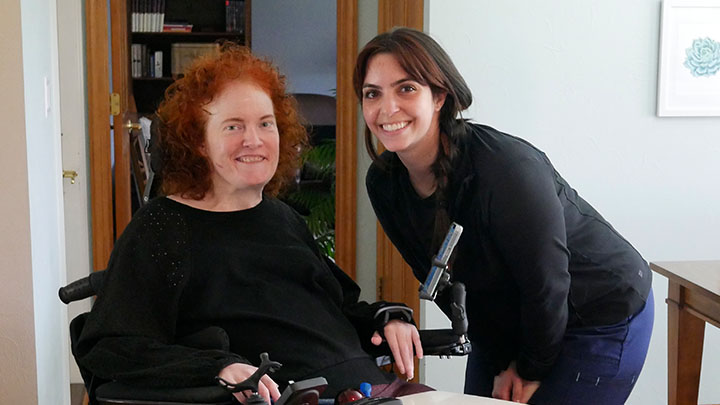

Slippery Rock University alumni like Gina Novario are trained to care for and collaborate with others to improve people’s lives. Novario, ’17, ’21 OTD, is part of a forward-thinking research team at the University of Pittsburgh’s Accessible Smart Tech Lab that provides technological solutions empowering people living with disabilities to improve their independence, participation and safety in daily tasks.
Novario, a native of Cleveland, Ohio, came to SRU knowing that she wanted to be an occupational therapist, thanks to her younger sister, Bella.
“I’m fortunate to have known what I wanted to do for a long time,” Novario said. “I have a younger sibling with Down syndrome, so growing up I was able to participate in her therapies. I really enjoyed what the occupational therapists were doing in her care, so I started undergrad knowing I needed a bachelor’s degree in science that would prepare me for that work.”
Novario was an exercise science major during her undergraduate years, and she took some time to work in the field after graduation, serving as a group exercise instructor and personal trainer in corporate settings. Then, in 2018, Novario returned to SRU to join the new Doctor of Occupational Therapy program.
“It felt like the perfect timing when the program started,” Novario said. “I was really happy to be able to continue my education at Slippery Rock.”
One of the important skills that Novario gained from her time at SRU was the ability to collaborate with other medical professionals in pursuit of optimal care for patients.
“In grad school, we would collaborate on case scenarios with students in other health professions,” she said. “We would work with nursing students and physical therapy students and discuss how to approach client situations and how to effectively work together.”
This experience helped Novario in her professional life as well, specifically in her research. Since 2021, Novario has worked on research teams in the University of Pittsburgh’s Accessible Smart Tech Lab, including the last four months as a research scientist. Her team provides services, including evaluation, selection, training and ongoing support, to research participants with disabilities, helping them successfully use smart home technology to improve their engagement in daily activities. Their findings inform practitioners, end users and care partners who could benefit from similar smart tech solutions.
“Drawing on our team’s therapeutic backgrounds, we implement client-centered approaches in our studies, an evidence-based practice we know to be most effective,” Novario said. “Our team is composed of everyone from occupational therapists to physical therapists to software and rehab engineers. It’s a lot of different people with different mindsets and approaches. Being able to communicate with each other helps us to support one another and to support our participants.”
Through these collaborative efforts, the research team gathered data demonstrating that participants decreased their level of assistance needed to complete identified goals while improving both their satisfaction and performance with daily activities. The team also focused on the cost-effectiveness and accessibility of these smart home solutions, ensuring that other clinicians and end users can benefit from their findings.
Novario, who continues to work part time as an occupational therapist for Encompass Health, also spoke to the importance of communication between professionals in clinical settings, noting its relevance to ensuring the best possible outcomes for patients.
“You never want to leave something out because you’re not willing to collaborate with someone else,” she said. “It’s crucial to be able to tap into others’ experience and expertise.”
Novario has also benefited from SRU’s emphasis on communication across differences on a patient or client level.
“You communicate with so many different people that it’s important to be able to meet them where they are and to be able to adapt your communication approach,” Novario said. “Sometimes you’re working with people who are having the worst day of their life, and they’re nervous or anxious or scared or maybe even mad. It’s your job as a clinician to adapt your approach to support that individual.”
Providing support and caring for people as they work toward their goals is the heart of Novario’s work.
“I love what I do because I love being able to be a part of someone’s care and to help them reach their goals,” she said. “In my research, I think it’s important that people who have a background in client-centered care help to make the research applicable in real life.”
Through her caring, solutions-based approach to her work, Novario is making a difference in the lives of her own clients and taking bold steps to make a difference for people around the country and the world through forward-thinking research.
More information about the exercise science and occupational therapy programs at SRU is available on each program’s webpage. More information about the Accessible Smart Tech Team is available on the University of Pittsburgh website.