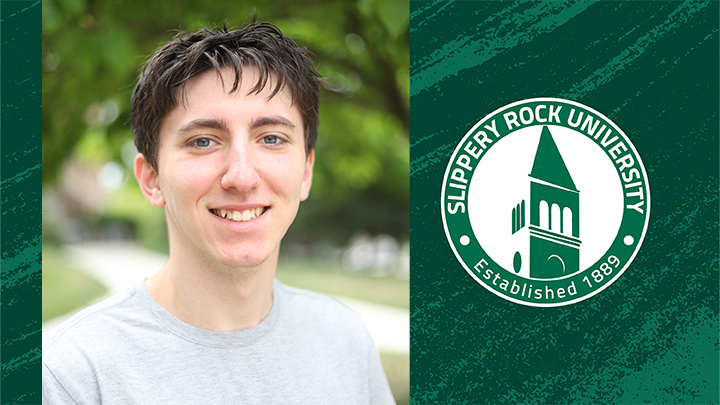

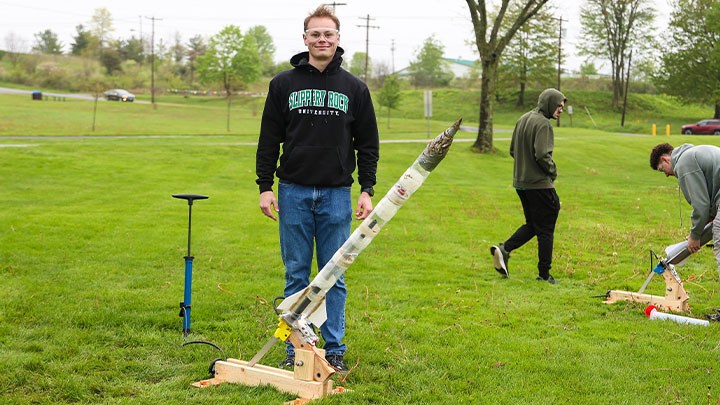

Ignited by his passion for building and science, Jacob Cerra is launching water rocket research to new heights at Slippery Rock University. Cerra, a junior mechanical engineering major from North Huntingdon (Norwin HS), is constructing better water rockets using principles of physics that can be applied anywhere from middle school classrooms to the NASA space program.
Cerra’s research at SRU provides new solutions for increasing the distance rockets can travel through the use of series pressure vessels.
“I’ve loved building stuff since I was a kid,” Cerra said, “it triggers my brain in a way that classroom work can’t, so this project really matched my interests.”
The project began in Cerra’s first-year seminar class when he produced rockets by taping two-liter bottles together, attaching a nose and fins, and launching them. This is the same kind of rocket launch that many might be familiar with from middle and high school science classes.
“I wanted to take it a step further,” Cerra explained. “So, I came up with a method where you splice the bottles together instead of just taping them and use a construction adhesive. The top part is just an air tank, the middle is a mix of water and air, and the bottom vessel is just water, which makes a series pressure vessel.”
The type of vessel that Cerra uses led to a demonstrable increase in distance for the bottle rockets, taking them from a maximum reach of 90 feet to 750 feet.
“This started as an educational tool, but it also uses the same principles of bigger, real rockets,” Cerra said. “If you can understand the principles of a water rocket, you can understand the principles of (NASA’s) Artemis rocket.”
While Cerra put countless hours into the project, utilizing skills developed through hard work, he also emphasized that research like this is fun.
“It’s about problem solving, but it’s about having fun,” Cerra said. “Who doesn’t love watching a rocket? You’re taking all of this work and putting it into something that’ll fly, or it won’t, and then you try again!”
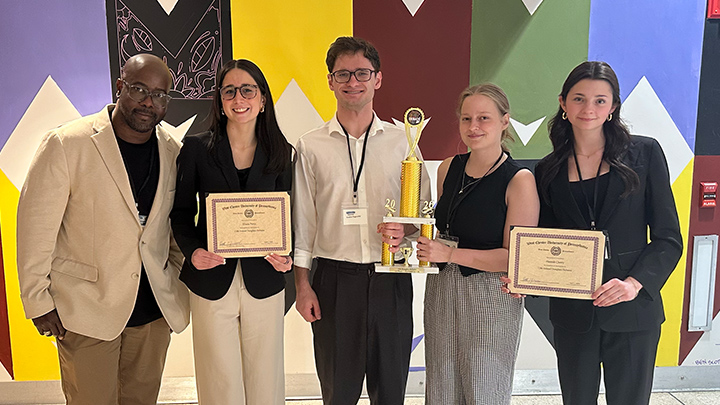
Cerra and other students from the Thermal System Design tested water-propelled simulations to study thermodynamics, fluids and dynamics, and a demonstration on campus earlier this year.
More information about engineering at SRU can be found on the program’s webpage.