
Nick Katsiadas, assistant professor of languages, literatures, cultures, and writing at Slippery Rock University, has released a new book exploring how ruins shape J.R.R. Tolkien’s legendary worlds
Students might not expect to see a book of essays on “The Lord of The Rings,” “The Hobbit” or “The Silmarillion” on their English lit syllabus, but a Slippery Rock University professor is bringing the scholarship of author J.R.R. Tolkien straight up to that level.
Nick Katsiadas, an SRU assistant professor of languages, literatures, cultures, and writing, has a new book out titled “Tolkien’s Medievalism in Ruins: The Function of Relics and Ruins in Middle-earth,” available now from Bloomsbury. Katsiadas, a lifelong Tolkien fan turned Tolkien scholar, edited and compiled this book with longtime colleague Carl Sell of the University of Pittsburgh.
“This is a passion project for both my co-editor and me because both of us got started in English because of Tolkien and ‘Lord of The Rings’ and ‘The Hobbit,’” Katsiadas explained.
Katsiadas’s literary interests also include romanticism, an artistic and intellectual movement that emerged in the late 18th century as a reaction against rationalism. Katsiadas was sought after for his expertise by the University of St. Andrews in Scotland, after the school identified him as one of the only scholars making romanticism relevant in a contemporary context. Through his work with St. Andrews, Katsiadas was asked to review Julian Eilman’s book “J.R.R. Tolkien: Romanticist and Poet.” It was through this experience that Katsiadas fully identified the need for more analysis of Tolkien’s work through lenses other than the common medievalist lenses it has been viewed through.
“It was just too strong a siren song,” Katsiadas said. “I knew I needed to do this.”
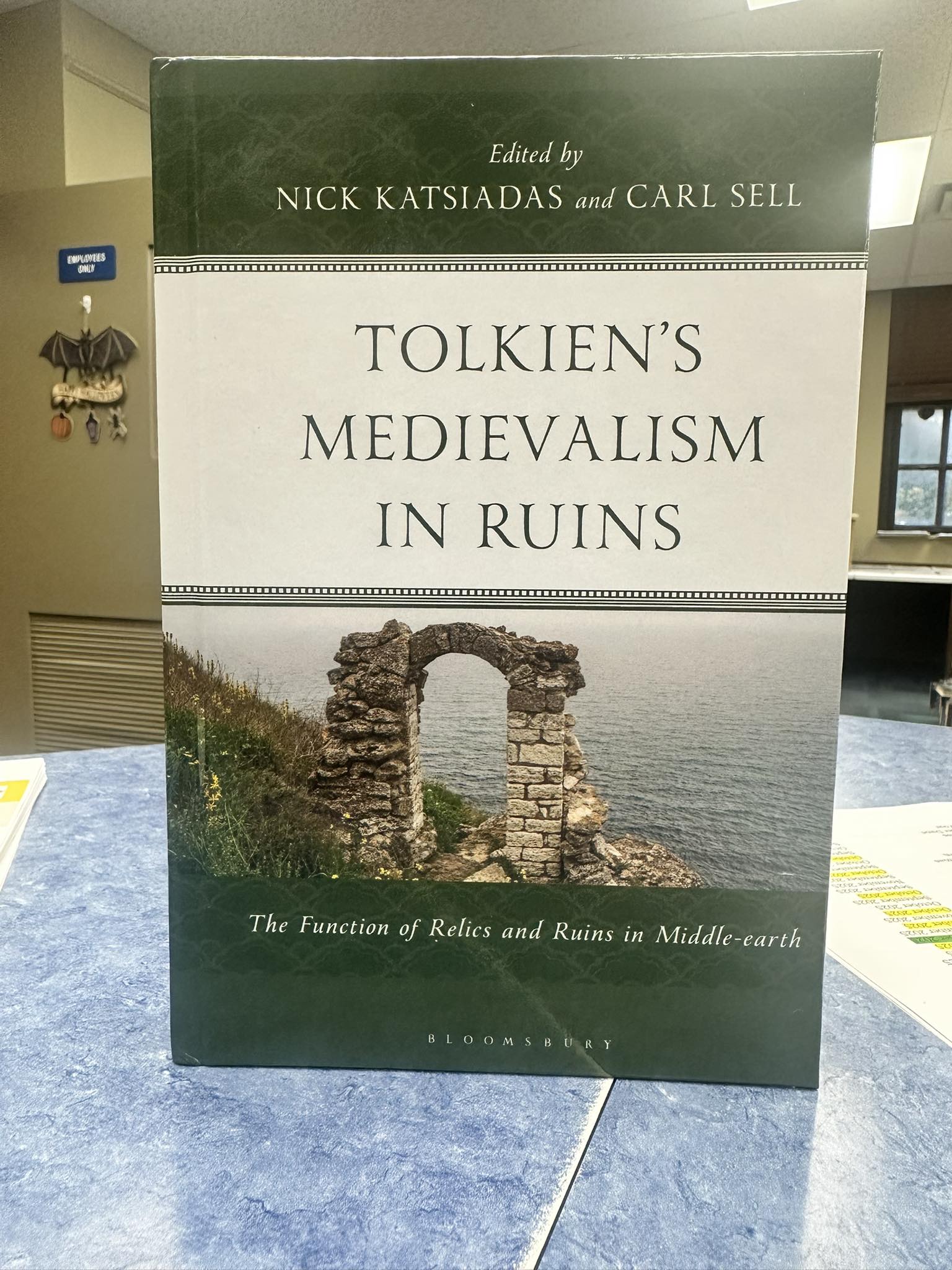
Katsiadas and Sell selected ruins as a specific area of interest for their book. While romanticism also heavily features ruins, Katsiadas and Sell argue that Tolkien is a modernist writer by virtue of the uniquely romantic treatment of ruins. This is because modernist writing is typified by the pushing of boundaries, something that Katsiadas and Sell argue Tolkien was doing through his treatment of medieval manuscripts. This expansion of Tolkien scholarship into romanticism and modernism as well as into areas of ludology — the study of games, especially video games — is what makes this book special. Katsiadas, like Tolkien before him, is pushing boundaries.
As a pop-culture scholar, Katsiadas advocates looking at texts that have historically been minimized as “popular” critically just as one would look at widely accepted “literary” works. Katsiadas says in no uncertain terms that pop-culture and literary studies are not mutually exclusive. They go hand in hand, and it is the job of contemporary literary scholars to make those connections and to encourage the next generation to do the same.
“What are we doing if we’re not making these texts that are so historically distant relevant to modern culture?” Katsiadas asked.
Students of Katsiadas’s have taken interest in this project as well, with one student, James Schultz, ’25, presenting his literary analysis of Tolkien at a recent national pop-culture conference in New Orleans under Katisadas’s mentorship.
“As a first-generation college student, it’s important to me to create opportunities like this for my students and to show them how to identify and create opportunities to publish their work,” Katsiadas said.
Katsiadas next plans to expand on the work he did in his recent publication, both through further writing on the subject and through teaching parts of the book in his classes.
“I would encourage students interested in pop-culture to follow their passion and their interests, because opportunities will open up,” Katsiadas said. “Don’t be afraid to march to the beat of your own drum!”