
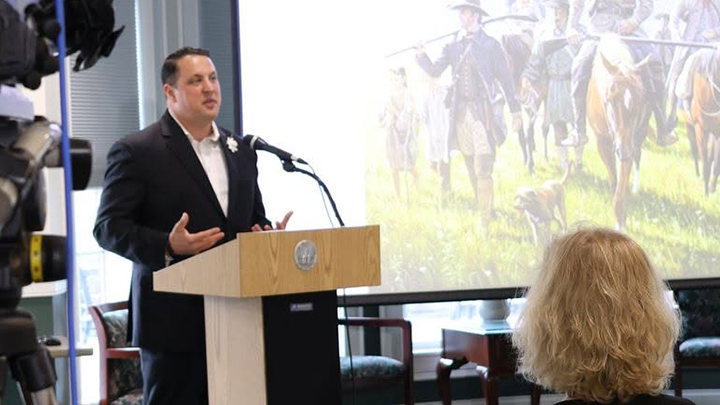
Slippery Rock University alumnus Brady Crytzer, ’08, ’10M, is making headlines for his eighth professional publication, “The National Road: George Washington and America’s First Highway West.” Reflecting on the local impact of the historic route that goes through southwestern Pennsylvania, Crytzer shared how the project bridges the grand scale of American history with the everyday lives of U.S. citizens.
“It’s very relevant for us, and most importantly for the people that read the book,” Crytzer said. “It gets them to look at where they live, a place they know really well, in a different way.”
Crytzer, who earned his bachelor’s degree in education and master’s degree in history at SRU, noted that the book itself tells the story of America’s westward expansion in the period after the Revolutionary War. “The National Road” is the first narrative history of the federal project which connected the United States across the Alleghenies and into the western frontier.
“The book is all about the perspectives of the people that made it possible,” Crytzer said.
The national road is widely considered to be America’s first interstate highway, carrying years of history within its construction. For Crytzer, looking back at this massive undertaking offered a much-needed dose of modern inspiration.
“I think that there’s something to be said for doing something –– making something, building something,” Crytzer said. “It’s important to believe that, as a country, we can achieve great things still. I think a lot of people are feeling down on that these days, like things can’t get better and it’s only worse from here. I don’t think that’s a very healthy way to look at things.”
With that perspective in mind, readers seem to crave that sense of inspiration. With reviews published in the Wall Street Journal and earned the “Editor’s Pick: Best History” by Amazon.com, , the overwhelmingly positive reception of “The National Road” has been fulfilling for Crytzer to see.
“It’s really gratifying,” Cryzter said. “When you write, it becomes a very lonely process. You have to lock yourself away in your writing and research, and that’s not a regular thing for people who are non-historians to do.”
For Crytzer, seeing the book make an impact brought a profound sense of relief and connection after months of research.
“As writers, we’re very much the outliers in society,” Crytzer noted, “so just being able to see people reading and enjoying the book is such a great thing for me.”
As Crytzer reflected on his process and reception, SRU’s impact on his professional career became readily apparent. He recalled arriving on campus with plenty of raw ambition, but very little direction.
“When I came to Slippery Rock, I knew I loved to write, research and investigate, but I didn’t really have a compass,” Crytzer said. “I didn’t even like history all that much either because I didn’t grow up with it. But then I had a professor named David Dixon.”
Dixon, ’76, ’83M, was a history professor at SRU from 1999 until he passed away in 2008.
“He was a professor like I had never had before,” Crytzer said. “His lectures were almost cinematic, and he carried such passion in what he did. Nothing was ever rehearsed; it all came from his heart. He was a purist, and he was also like my mentor. Sometimes I go back and read my old notes from his class. They still resonate with me.”
This mentorship, as well as the educational support from SRU, ultimately acted as the catalyst for Crytzer’s career moving forward. Looking back, he credits the University as a major facet of his current success.
He is one of the leading experts in the frontier history of North America, he is the associate editor of the Journal of the American Revolution, and he regularly appears on Fox News, NBC Peacock, C-Span, and Sirius XM. In 2026, Crytzer was named a Fellow at the Royal Society of Arts in London. His work has been featured in The Washington Post, The Wall Street Journal, Sirius XM and USA Today. He also teaches history at Robert Morris University.“SRU is central to my academic journey, I wouldn’t be here without it,” Crytzer said.
More information about “The National Road” and its author can be found on Crytzer’s website, bradycrytzer.com.