With growing concerns about the accuracy of wrist-worn health devices, a Slippery Rock University student is charting a course toward better results through undergraduate research.
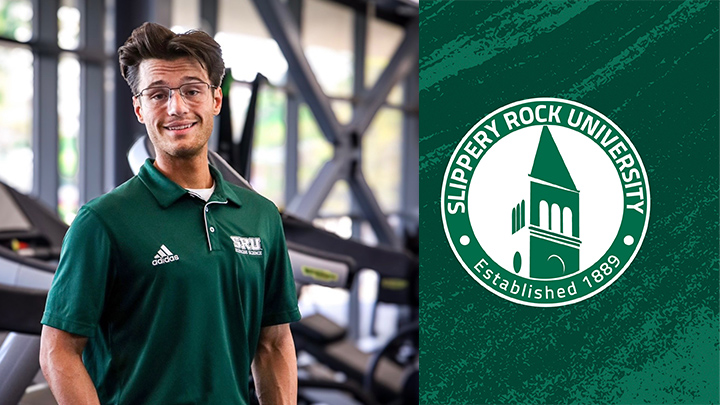
Matthew Deemer, a senior exercise science major from Zelienople (Seneca Valley HS), is leading a research project titled “Validation of Wrist-Worn Devices for Blood Pressure Measurement.” The project is funded through the Slippery Rock University Faculty & Student Research Grant Program.
“It’s been an amazing process to go through,” Deemer said. “I’m learning the ins and outs of research, helping others and talking with people about a project that is going to have a direct influence on them and their lives.”
Navigating the health care system can be complex, particularly for individuals who experience stress or anxiety when visiting a doctor. For some, this discomfort can directly impact medical readings and lead to misleading results.
“Recently, when we think about blood pressure and its clinical significance, there’s a rather common phenomenon called ‘white coat syndrome,’” Deemer explained. “This term refers to when people experience a rise in blood pressure simply from being in a clinical setting. That can lead to a false flag, or a diagnosis of high blood pressure, which in actuality, their blood pressure is normal.”
In response to this issue, the health care market increasingly shifted toward at-home blood pressure monitoring. However, new challenges emerged, as traditional devices that provide accurate readings are often bulky and inconvenient. They are less practical for consistent, everyday use.
“To further address this, we’ve seen within the past 5-10 years the development of wrist-worn blood pressure devices,” Deemer said. “You see an Apple Watch on every other wrist around campus. Now, we can see that the validity testing on blood pressure devices has room to be improved.”
Deemer’s study comes into play when looking at blood pressure under specific conditions.
“Previous work within our laboratory has shown that there could be a difference in blood pressure between arms,” Deemer said. “That’s an area where we might have a false positive. Whenever you do any physical activity, you can have a blood pressure spike. A lot of the devices that we wear aren’t validated under conditions where you might have a type of postural change. We wanted to address these concerns.”
Deemer, along with Mingchia Yeh, an assistant professor of exercise science, ran tests to measure blood pressure through various conditions, not just resting.
“Not only are we testing a great idea, but were also working to improve the standards of which we test devices,” Deemer said. “I hope that this project shakes up how we do validity testing. If someone’s watch is giving the wrong values, there needs to be a study that says that. This will help hold companies accountable, especially for something as important as blood pressure.”
Deemer, who plans to graduate in May, is also currently working with a new student co-investigator for this project, Brady Blakeslee, a sophomore exercise science major from Union City (Union City HS).
“A lot of the feedback we got was that people wanted to see more data points, so I’m training a new student right now,” Deemer said. “We’re training him to take over with a new team of researchers to continue to gather more data.”
The team of researchers involved in this project want to give all wrist-worn test devices a chance to prove themselves. They did not want to leave any stones unturned. Deemer has a strong focus on setting up this project for future students to get involved with, as well as help increase the validity of wrist-worn blood pressure devices.
“A culture of excellence is only great if we continue to carry it on,” Deemer said. “If we continue to do high-level, impactful research, while also developing the students at SRU, it proves that even a smaller university can have a massive impact.”
Deemer made it clear that the project would not have been possible without the dedicated support of SRU and its faculty. Their investment in student and faculty research created the foundation that allowed the team to carry out meaningful and effective work.
“All expenses for the research project were funded by the University’s research grant, along with support from the College of Health Professions and the Exercise Science Department for conference travel to disseminate the research findings,” Deemer said. “This study was only possible because of them and the University’s assistance. The support from the University, college and department enables us to pursue excellence.”
For Deemer, the experience reflects not only his own academic growth, but also the value of choosing a university committed to fostering student-driven research.
“This whole process has been amazing,” Deemer added. “I’m very happy that I picked SRU and that I go to a university that supports these initiatives.”
More information about the exercise science program at SRU can be found on the program’s webpage.