At Slippery Rock University, growth happens when people step beyond what they know, learn from others and bring new perspectives back to their communities. It’s about understanding, and for Becky Thomas, that word took on deeper meaning, especially when translated from the Thai phrase ความเข้าใจ.
Thomas, an SRU professor of parks, conservation and resource management, spent the Spring 2026 semester on sabbatical studying abroad in Chiang Mai, Thailand, learning about Thai language, culture and culturally responsive conservation education.
“The Thai phrase for understanding resonated with me throughout the semester,” Thomas said. “It’s really something I sought to gain throughout my time in Thailand –– understanding of language, culture, environmental issues, conservation and, ultimately, myself.”
The project combined intensive language study, participant observation, field-based learning, interviews and collaboration with universities, government agencies, non-governmental organizations and local communities.
“I learned from professionals working in conservation, environmental education, sustainable agriculture, forestry, fisheries, Indigenous education, wildlife management, restoration ecology and community-based tourism,” Thomas said. “These experiences included participant observation in environmental education programs, lectures and field courses, site visits, interviews and extensive field note collection. I also spent considerable time out and about in the community practicing my Thai in everyday situations. I had the opportunity to visit five different provinces in three regions of Thailand.”
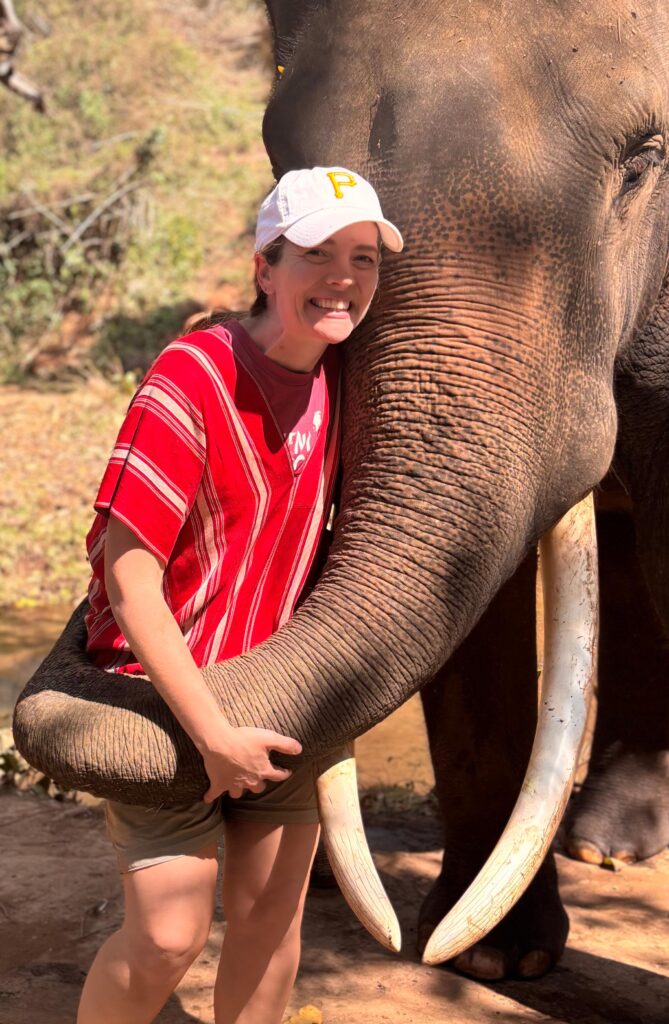
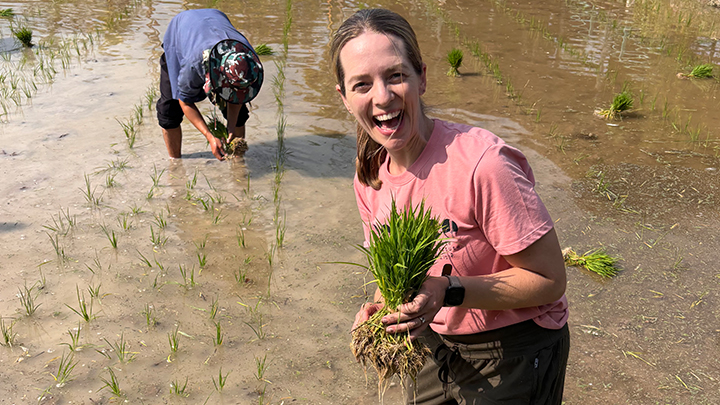
Thomas gained a firsthand understanding of many aspects of sustainability within Thai villages, from approaches to ethical elephant tourism to agricultural practices. This included her time visiting Baan Huay Hee, a Pga K’nyau (Karen) community in Mae Hong Son Province, where generations of local ecological knowledge shape how people manage the surrounding forest.
“There’s often a false assumption that to protect forests and other ecosystems you must separate people from them,” Thomas said. “The Thai communities that I observed effectively balanced conservation with the human use of resource.”
Thomas is developing case study examples that will be disseminated to students enrolled in her SRU courses delivered through the lens of her field experiences. The outcomes of this will facilitate student success through new and relevant international case studies. Her project will also open opportunities for cross-cultural exchange for both SRU and Thai students.
“This experience will continue to shape both my teaching and research, particularly how I approach questions about whose knowledge counts in conservation and how environmental education can better recognize the relationships among culture, livelihoods and ecological knowledge,” Thomas said.
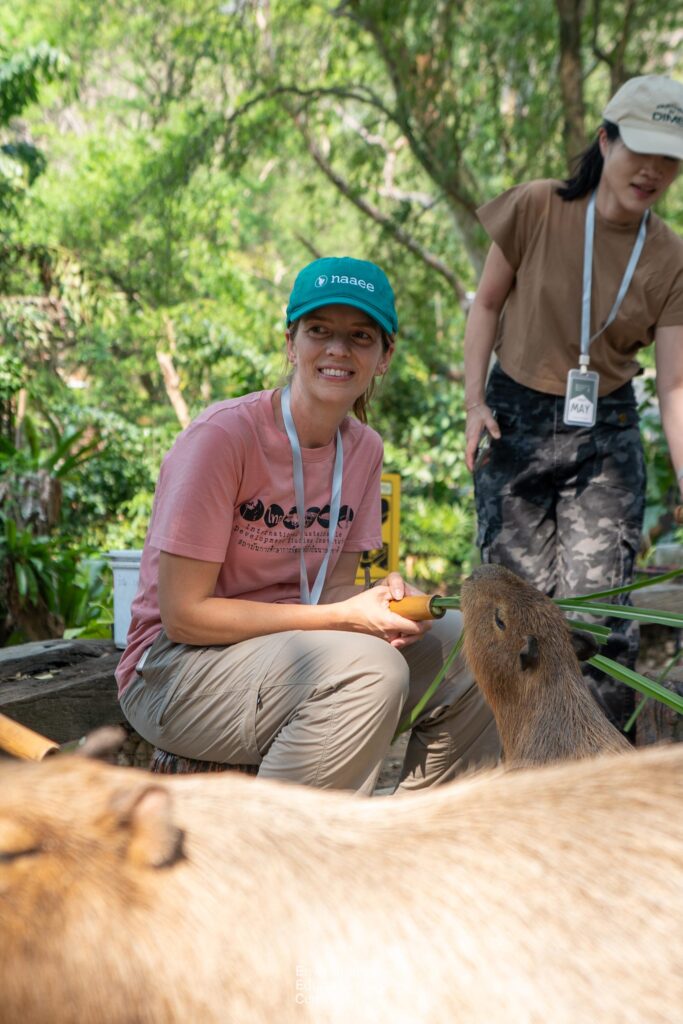
Thomas’ project was supported by a grant from Pennsylvania’s State System of Higher Education. She also worked in partnership with the International Sustainable Development Studies Institute and the Environmental Education Centre of Thailand to enhance her skills and knowledge directly from the people of Thailand.
The EEC provides family-friendly environmental education programming, and having Thomas’ 8-year-old son, Tee, join her during their six-month stay provided additional context as a participant and learner embedded in the communities.
“Having an 8-year-old experience many of these places and programs alongside me added another dimension to my work as an educator,” Thomas said. “He attended school in Chiang Mai, became increasingly comfortable communicating in Thai, and participated with me in several experiential environmental education programs, including programs with the Environmental Education Centre of Thailand.”
For Thomas, Tee’s involvement fortified the importance, and established a concrete connection between cultural immersion and conservation education.
“Experiencing environmental education alongside him also gave me an opportunity to observe these programs through the eyes of a child and to think more intentionally about how young people develop relationships with wildlife, ecosystems, communities and place,” Thomas said. “At the same time, watching him deepen his own connection to Thai language, culture and environment reinforced something that became increasingly important throughout my sabbatical: environmental and conservation education does not happen separately from culture, language and relationships.”
This type of first-hand education proved beneficial for Thomas.
“Instead of me coming in as an expert from the outside,” Thomas said, “I was there to learn from the local people who are interacting with the environment in that place.”
As a testament to that idea, Thomas found herself fully immersed during her sabbatical, as she received more than 70 language-learning sessions with a private instructor from ISDSI. By the end of her time in Thailand, she was able to speak Thai at an intermediate level, which, according to international standards, means that she can handle everyday situations and express opinions fluidly.
“Without speaking the language, I would not have gained the understanding,” Thomas said. “Culture is embedded in language and that is a crucial part of the work that we do in conservation education.”
As a result of these partnerships, Thomas plans on pursuing a Fulbright award to continue collaborative work in Thailand, focusing on culturally responsive environmental education and community-based conservation. Relations between Thomas and ISDSI have also laid a foundation for returning to Thailand in future summers, beginning in 2029, to further collaborate on professional development opportunities.